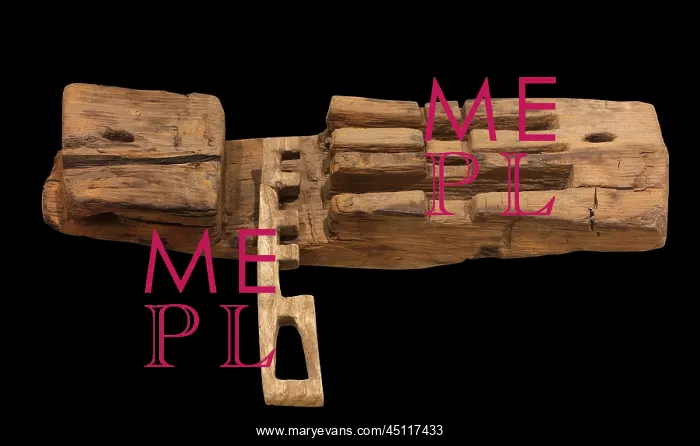
Roman lock and key, Vindolanda Museum, Hadrian's
Roman wooden lock and key from Vindolanda Fort, in the Vindolanda Museum, Hadrian's Wall, Northumberland, England. Guards patrolled the fort walls and turrets, and each day a new password was created to allow access to the fort. The tesserarius was the soldier in charge of the tessera, the token holding the day's password. Within the fort there were many restricted areas, including the strong room where soldier's pay and other funds were kept. Elaborate locks and padlocks show that despite the disciplinary regime, precautions had to be taken to protect valuable goods. Hadrian's Wall was built 73 miles across Britannia, now England, 122-128 AD, under the reign of Emperor Hadrian, ruled 117-138, to mark the Northern extent of the Roman Empire and guard against barbarian attacks from the Picts to the North. The Vindolanda Museum is run by the Vindolanda Charitable Trust and forms part of the Hadrian's Wall UNESCO World Heritage Site. Picture by Manuel Cohen
Pick your License
Restrictions Only for Ireland and United Kingdom and United States Of America
Aelium Artefact Boundary Charitable Excavated Frontiers Hadrian Hadriani Limit Northumberland Picts Vallum Vindolanda
Features In These Collections
> Contributors > COH