
Astronaut - Comets - NASA - Space - Spacecraft - UFOs
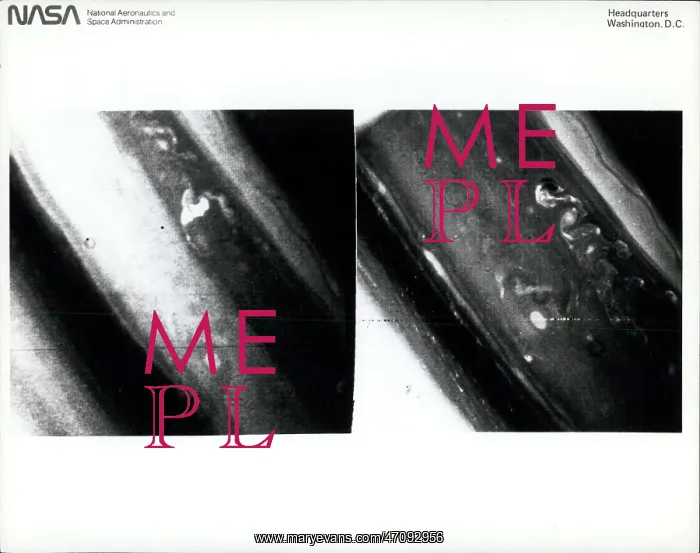
Aug. 23, 1981 - This comparison shows Saturn's north temperate region as viewed Nov. 5, 1980, by Voyager 1 (left) and Aug. 21 by its sister craft, Voyager 2, from a range of 5 million kilometers (3.1 mission miles). The large bright oval feature in the lower right of each frame measures about 2, 500 km (1, 550 ml.) across. This feature, a gigantic storm system in the planet's atmosphere, was first observed by Voyager 1 almost exactly one year ago. Thus, as on Jupiter, some storms in Saturn's atmosphere are quite long-lived compared to their smaller terrestrial counerparts. By contrast. the pattern of convective disturbances to the north (upper right) undergoes rapid changes in a matter of even a few days. In some aspects, these features resemble gigantic thunderstorms.The largest bright feature in the Voyager 1 photograph extends about 7, 500 km. (4, 650 ml.) from north to south. These giant storms lie within one of the strong westward-flowing currents observed in the atmosphere, with wind speeds of about 20 meters-per-second ((45mph) The smallest visible features here are about propulsion laboratory, Pasadena, Calif
Pick your License
Restrictions Only for United Kingdom
Aspects Calif Changes Compared Comparison Contrast Currents Disturbances Exactly Extends Feature Gigantic Jupiter Kilometers Measures Observed Pasadena Propulsion Quite Rapid Resemble Saturns Smaller Smallest Speeds Storms Temperate Terrestrial Thus Undergoes Viewed Visible Voyager
Features In These Collections
> Contributors > KEY


