
Astronaut - Comets - NASA - Space - Spacecraft - UFOs
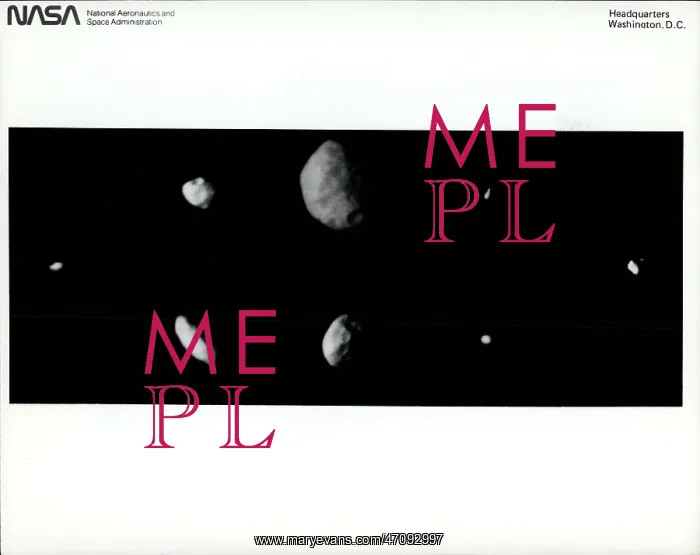
Aug. 30, 1981 - This family portrait shows the smaller satellites of Saturn as viewed by Voyager 2 during its swing through the Saturian system. The following chart corresponds to this composite photograph (distance from the planet increases from left to right) and lists names, standard numerical designations and approximate dimensions (radii where indicated) in kilometers: --------------------------------------------------------------------------- 1980S26 1980S1 1980S25 Outer F-ring Leading Trailing shepherd co-orbital Tethys trojan 120 by 100 220 x 160 rad: 25 1980S28 1980S27 1980S3 1980S13 Outer A Inner F-ring Trailing Leading shepherd co-orbital Tethys tojan rad: 30 145 x 70 140 x 100 rad: 30 --------------------------------------------------------------------------- These images have been scaled to show the satellites in true relative sizes. This set of small objects range in size from small asteroidal scales to nearly the size of Saturn's moon Himes. They are probably fragments of somewhat larger bodies broken up during the bombardment period that followed accretion of the Saturnian system. Scientists believe they may be mostly icy bodies with a mixture of meteorite rock. They are somewhat less reflective than the larger satellites, suggesting that thermal evolution of the larger moons cleaned up their icy surfaces. The Voyager project is managed for NASA by the Jet Propulsion Laboratory, Pasadena, Calif
Pick your License
Restrictions Only for United Kingdom
Accretion Approximate Believe Bombardment Calif Cleaned Composite Corresponds Designations Followed Fragments Himes Kilometers Larger Less Lists Managed Meteorite Mixture Moons Mostly Names Nasa Nearly Numerical Pasadena Propulsion Reflective Relative Satellites Saturn Saturnian Saturns Scaled Scales Scientists Sizes Smaller Somewhat Suggesting Surfaces Tethys Thermal Trailing Trojan Viewed Voyager
Features In These Collections
> Contributors > KEY


