Emancipation
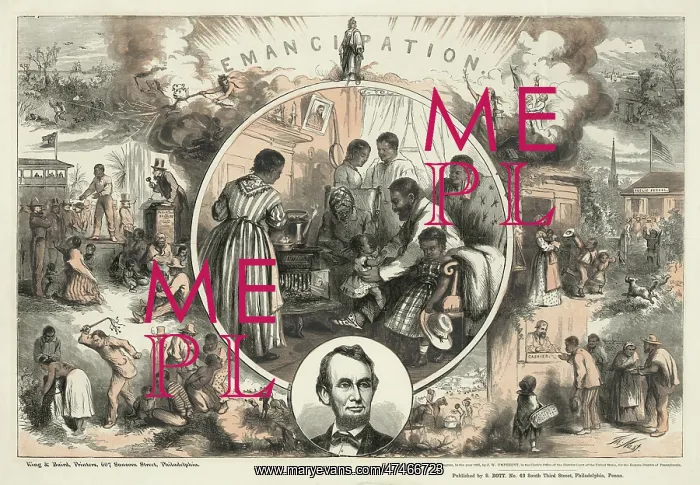
Emancipation. Thomas Nast's celebration of the emancipation of Southern slaves with the end of the Civil War. Nast envisions a somewhat optimistic picture of the future of free blacks in the United States. The central scene shows the interior of a freedman's home with the family gathered around a Union wood stove. The father bounces his small child on his knee while his wife and others look on. On the wall near the mantel hang a picture of Abraham Lincoln and a banjo. Below this scene is an oval portrait of Lincoln and above it, Thomas Crawford's statue of Freedom. On either side of the central picture are scenes contrasting black life in the South under the Confederacy (left) with visions of the freedman's life after the war (right). At top left fugitive slaves are hunted down in a coastal swamp. Below, a black man is sold, apart from his wife and children, on a public auction block. At bottom a black woman is flogged and a male slave branded. Above, two hags, one holding the three-headed hellhound Cerberus, preside over these scenes, and flee from the gleaming apparition of Freedom. In contrast, on the right, a woman with an olive branch and scales of justice stands triumphant. Here, a freedman's cottage can be seen in a peaceful landscape. Below, a black mother sends her children off to Public School. At bottom a free Negro receives his pay from a cashier. Two smaller scenes flank Lincoln's portrait. In one a mounted overseer flogs a black field slave (left); in the other a foreman politely greets Negro cotton-field workers. Date c1865. Emancipation. Thomas Nast's celebration of the emancipation of Southern slaves with the end of the Civil War. Nast envisions a somewhat optimistic picture of the future of free blacks in the United States. The central scene shows the interior of a freedman's home with the family gathered around a Union wood stove. The father bounces his small child on his knee while his wife and others look on. On the wall near the mantel hang a picture of Abraham Lincoln and a banjo. Below this scene is an oval portrait of Lincoln and above it, Thomas Crawford's statue of Freedom. On either side of the central picture are scenes contrasting black life in the South under the Confederacy (left) with visions of the freedman's life after the war (right). At top left fugitive slaves are hunted down in a coastal swamp. Below, a black man is sold, apart from his wife and children, on a public auction block. At bottom a black woman is flogged and a male slave branded. Above, two hags, one holding the three-headed hellhound Cerberus, preside over these scenes, and flee from the gleaming apparition of Freedom. In contrast, on the right, a woman with an olive branch and scales of justice stands triumphant. Here, a freedman's cottage can be seen in a peaceful landscape. Below, a black mother sends her children off to Public School. At bottom a free Negro receives his pay from a cashier. Two smaller scenes flank Lincoln's portrait. In one a mounted overseer flogs a black field slave (left); in the other a foreman politely greets Negro cotton-field workers. Date c1865
Pick your License
Apart Apparition Auction Banjo Blacks Bounces Branded C1865 Cashier Cerberus Confederacy Contrast Contrasting Either Emancipation Flank Flee Flogged Foreman Fugitive Gleaming Greets Hags Hang Hunted Knee Mantel Nast Negro Olive Optimistic Overseer Politely Preside Scales Sends Slaves Smaller Somewhat Stove Swamp Triumphant Visions
Features In These Collections
> Contributors > MEC