Lieutenant-General The Honourable Robert Monckton
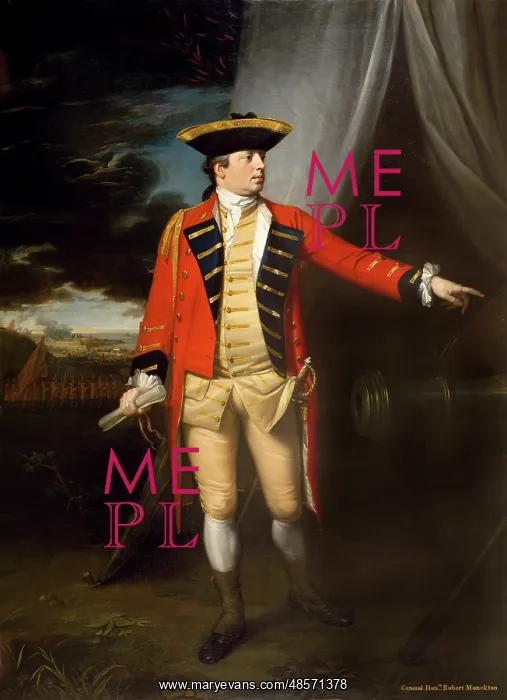
Major-General (later Lieutenant-General) The Honourable Robert Monckton (1726-1782), at the Taking of Martinique, 1762.Oil on canvas by Benjamin West (1738-1820), 1763/4 (c), exhibited at the Society of Artists 1764.Listed in 1762 as a major-general (he later became a lieutenant-general), Monckton is wearing a general officer's frock coat: the single-spaced buttons and loops were later to be used to denote full generals. Still in his thirties, Monckton was a tall, imposing figure, who received the thanks of the House of Commons for his valiant conquest of Martinique.Monckton's military career was largely centred in North America, most significantly as General Wolfe's second-in-command at Quebec in 1759. From 1761-1763, he was Governor of New York. It was thus no coincidence that he chose the young American artist, Benjamin West, to record his grandest moment for posterity. In 1763 West had just arrived in London, en route from Italy to his native Pennsylvania, when he received the commission. His interpretation of the dignified general, with its fashionable Neo-Classical allusion to the Apollo Belvedere, was so successful that it was one of three paintings exhibited in 1764 that launched West's career in England. West went on to receive royal patronage and, in 1792, succeeded Sir Joshua Reynolds as President of the Royal Academy. In its day, his most famous painting, The Death of General Wolfe, (National Galleries of Canada), was innovative for treating a contemporary subject as a formal, academic history painting, with the principals dressed in their own clothes, as opposed to classical robes.The map in Monckton's right hand and the left-hand detail of the portrait make direct allusion to the most crucial part of the capture of Martinique. There had previously been several unsuccessful British attempts to take this important sugar island. In 1762 it was heavily garrisoned with over 12, 000 French soldiers, local militia and hired privateersmen'. Monckton assembled his force in Barbados, amounting to about 8, 000 troops in total, including 5, 000 British redcoats from America, and local volunteers from the British-held islands of the West Indies (Barbados, Antigua, Montserrat, St Christopher and Nevis).They landed in Martinique on 16 January 1762 and began the arduous task of hauling the artillery across various gullies and ravines, but found the way blocked by a number of redoubts held by local militiamen. Monckton was forced to set up batteries to take these and his force fought all the way - at a cost of nearly 400 killed and wounded, to where the French had retreated, Fort Royal and Morne Grenier, an adjacent hill. On 27 January the French made a daring attack which failed, while the British gave chase up Morne Grenier and took the position.Fort Royal surrendered a few days later and within nine days the whole island had capitulated. Monckton immediately sent detachments off to take the neighbouring islands of St Lucia, Grenada and St Vincent, bringing all of the Leeward and Windward Islands under British control. They remain part of the British Commonwealth today
Pick your License
1762 1763 1764 Allusion Belvedere Centred Chose Coincidence Commission Denote Dignified Exhibited Frock Grandest Honourable Imposing Interpretation Largely Loops Martinique Monckton Posterity Quebec Significantly Spaced Thanks Thus Valiant
Features In These Collections
> Contributors > NAM