
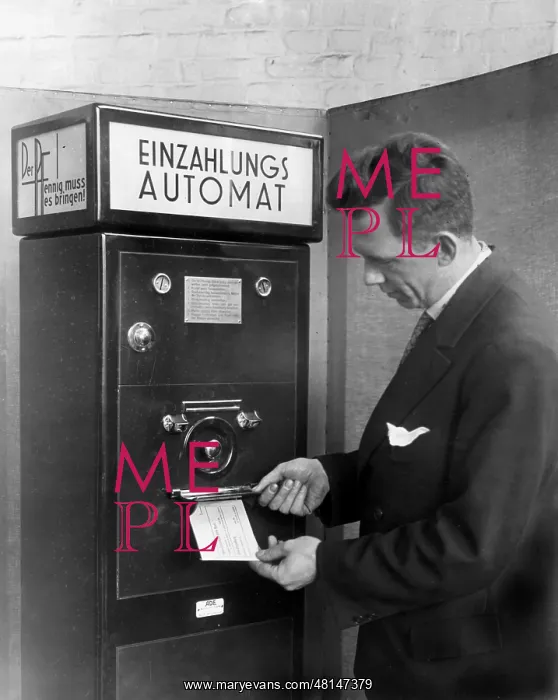
Bank deposit machine, 1931
An automat is installed in banks and savings institutions that should simplify time-consuming procedures when depositing. When one inserts ten pfennigs, the machine dispenses an envelope and a metal token. The envelope is for the money the client wishes to deposit and has an identification number on it. This identification number is located on a slip, connected to the envelope, which the client retains. After filling the money envelope, the metal token is dropped into the second slot. Then the door for the money envelope automatically opens and the envelope falls into an armored safe. This safe is emptied daily by two employees of the savings institute, who collect the amount to be deposited. The identification slip serves as proof for the depositor to register later into his bankbook
Pick your License
Restrictions Only for Canada and Curacao and United Kingdom and United States Of America
Amount Automat Automatically Banking Client Collect Computing Connected Consuming Deposit Deposited Depositing Dispenses Dropped Economics Employees Emptied Envelope Filling Identification Inserts Installed Institutions Macro Pfennigs Procedures Proof Register Retains Safe Savings Serves Simplify Slip Slot Token Wishes
Features In These Collections
> Contributors > SDZ


