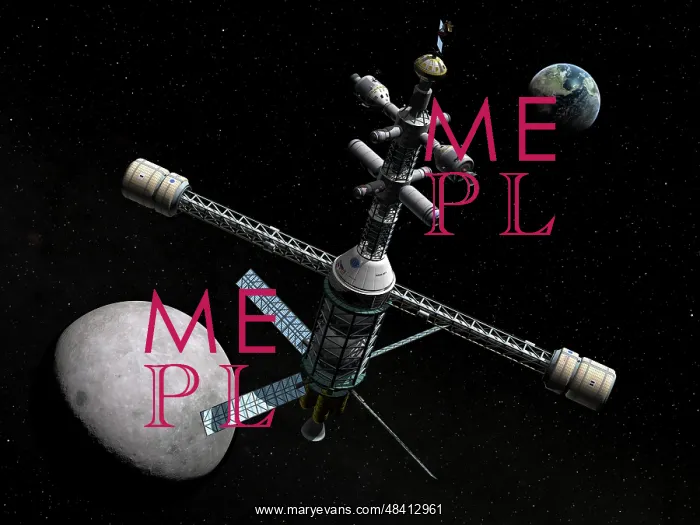
Artist's concept of a lunar cycler
A lunar cycler has reached its furthest orbital point from the Earth, the apogee, and is rounding the far side of the Moon to begin its fall back toward Earth. At apogee the lunar cycler is about 300 thousand miles from the Earth and 50 thousand miles beyond the orbit of the Moon (further from Earth than any human has ventured yet). Based upon what may be technologically feasible within the next 75 years, this is a suggestion of what a lunar cycler might one day look like. This cycler would be 200 feet long (about the height of a 20-story building) and accommodate 12 passengers and crew. A 200 foot centrifuge bisects the cycler tower and provides artificial gravity for the wayfarers. If frequent manned trips to the Moon become a reality, the earlier throw-away technologies of the Apollo lunar missions will be impractical for the long term. More efficient and reusable systems will need to be developed in order to minimize the labor and resources required for these extraordinary voyages. A journey to the Moon can be broken down into three basic tasks: transfer between the Earth's surface and Earth orbit, transfer between Earth orbit and lunar orbit, and transfer between lunar orbit and the Moon's surface. While the simplest solution may be a single vehicle that could do all three, no technology today or in the foreseeable future can meet all these needs. One solution would be to dedicate separate vehicles for each of the three tasks. A reusable space shuttle would lift explorers off the Earth's surface, a dedicated and reusable lunar shuttle would deliver explorers to the Moon's surface and back, and in between there would be a kind of orbital way station. One such way station is known as an orbital cycler. An orbital cycler is a vehicle that's in a permanent orbit around two celestial masses. In the case of a lunar cycler, the orbit would encompass both the Earth and the Moon. One lunar cycler proposal would place the cycler in a highly elliptical Earth/Moon orbit. The lunar cycler would complete an orbit every two weeks, and make a close approach to the Moon every other orbit. The cycler journey from the Earth to the Moon would take about a week
Pick your License
Artificial Assist Astronautical Astronautics Astronomical Astrophysics Automated Centrifuge Cycler Delivering Departing Gravity Hypothetical Lunar Orbit Orbiter Probe Probes Rendition Satellite Satellites Solar Spacecraft Spaceflight Surreal Trajectory
Features In These Collections
> Contributors > STO