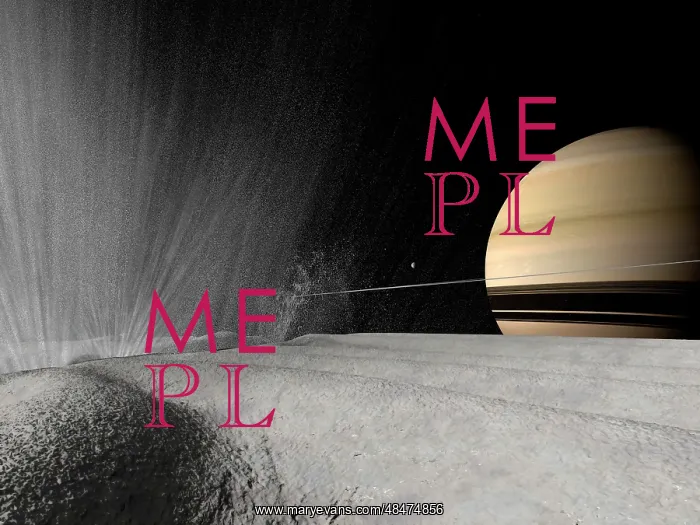
Illustration of a geyser erupting on the surface of ?
Illustration of a geyser erupting on the surface of Enceladus. Liquid water reaches the surface of Enceladus south pole and drives a massive plume of ice crystals into the sky. The combination of Enceladus low surface gravity and the geyser's force accelerate the crystals to escape velocity, where sunlight breaks the water molecules down into their constituent atoms of hydrogen and oxygen. Saturn itself appears low on the horizon due to the proximity to Enceladus pole. The small object immediately to Saturn's left is another icy moon named Mimas. Somewhat smaller than Enceladus and closer to Saturn, Mimas sprints around Saturn in slightly less than one Earth day. In March 2006 NASA's Cassini probe revealed evidence of water-driven geysers on the surface of Enceladus. At first glance Enceladus doesn't seem to be a likely host for liquid water as the surface is extremely cold, about -330oo F. However, tidal forces from Saturn's massive gravity alternately pull and push on Enceladus interior, creating enough heat to melt the water ice immediately beneath the surface. This heated water is believed to periodically erupt like a volcano, a process known as cryovolcanism
Pick your License
Astrobiology Astrogeology Astronomical Astrophysics Burst Cosmology Crystals Discharge Emitting Enceladus Erupting Eruption Exobiology Exogeology Feature Geyser Giants Hydrodynamics Jovian Landform Lunar Mimas Mist Moons Outburst Permafrost Planetary Planets Plume Plumes Releasing Satellites Saturn Saturnian Solar Spout Spraying Surreal Terrain Universe Volcanic Volcano
Features In These Collections
> Contributors > STO