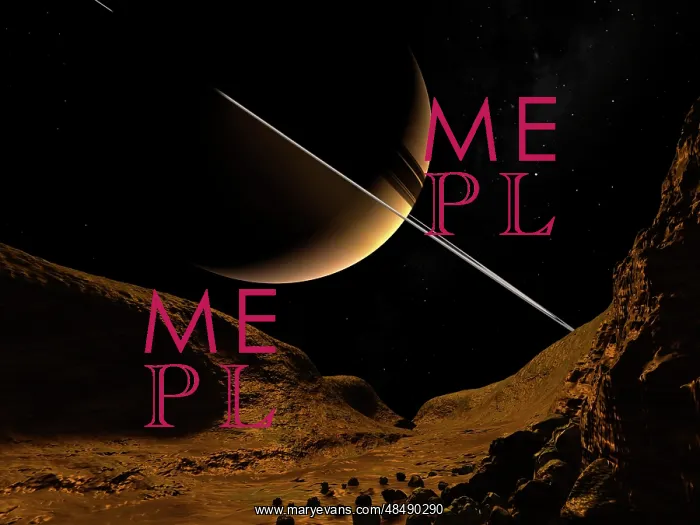
Illustration of Saturn from the icy surface of Enceladus
Artist's concept of how Saturn may appear from the icy surface of Enceladus, one of Saturn's eight major satellites. At a distance of 148 thousand miles, Saturn would subtend an angle of 29E?@ in Enceladus sky, about the same width as 58 Earth moon's lined up side-by-side. While the surface of Enceladus is as reflective as new fallen snow, it would probably appear leaden about an hour before sunrise with a crescent Saturn as the only source of illumination. Like all of Saturn's major satellites, Enceladus always keeps the same side facing its host planet. From the perspective of a stationary observer on Enceladus, Saturn would always appear in the same position in the sky, cycling through its phases in about one-and-half Earth days. This image also illustrates a phenomenon only recently discovered by NASA's Cassini probe: sunlight reflecting off of Saturn's rings casts a faint glow onto the cloud tops of Saturn's night side. The illumination is about the same as three of Earth's full moon combined
Pick your License
Astrobiology Astrogeology Astronomical Bumpy Canyon Cosmic Cosmology Crater Enceladus Escarpment Exobiology Exogeology Feature Giants Gorge Gully Highlands Jovian Landform Lunar Moons Planetary Planets Ravine Rendition Satellites Saturn Saturnian Scarp Solar Steep Surreal Terrain Topography Universe
Features In These Collections
> Contributors > STO