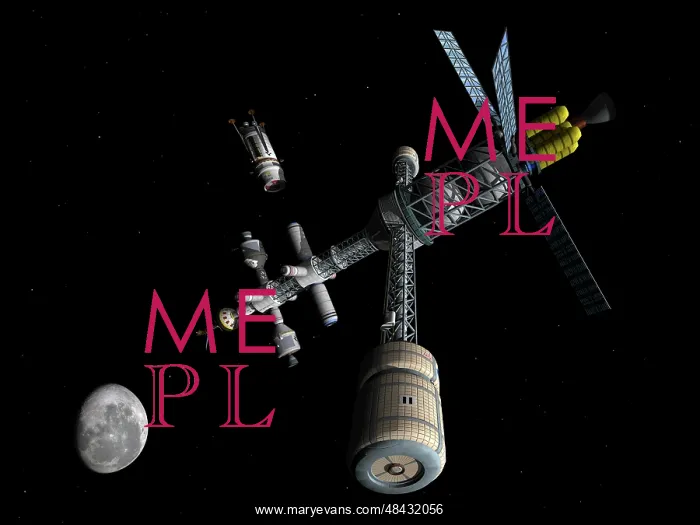
Lunar cycler centrifuge
A living quarters module, secured to the end of a centrifuge boom, swings into the foreground while an unmanned cargo ship prepares to dock in the upper left. Both are falling toward the moon at a leisurely 1, 500 miles per hour. On the upper right abutting the orange propellant tanks, is the blue glow of one of the cycler's four ion engines. These engines may be all that's required to maintain the long-term integrity of the cycler's orbit. Studies have shown that human health can suffer in the absence of gravity. Physiological hazards include loss of bone mass and diminished cardiovascular performance. While regular exercise can mitigate microgravity's deleterious effects, it may be determined that the best therapy would be a simulated gravity environment. Unfortunately nature appears to offer few options for simulating gravity, however a technologically feasible solution would be the employment of a centrifuge. A centrifuge is a mechanical device that puts an object in rotation around a fixed axis, resulting in a gravity-simulating force perpendicular to the axis. Small scale centrifuges are used on Earth to quickly separate substances of varying density. In the microgravity of space, a large centrifuge could be constructed, not to separate substances, but to simulate gravity for human occupants. In the image above envisions a centrifuge with two booms, each with a radius of 100 feet, and each secured to a living quarters module with accommodations for six. A rotation rate of two revolutions per minute would generate a force equal to one-sixth the gravitational force at the Earth's surface, which happens to be that of the moon's. Given the enormous engineering challenges, it would have to be demonstrated that even a force of one-sixth the Earth's gravity would go a long way toward ensuring human health. (Of course, larger centrifuges have been envisioned, from the massive two-wheeled space station in the movie 2001: A Space Odyssey, to a tethered version with a radius of a half-mile under consideration for Mars missions.) While spinning a centrifuge at a faster rate would simulate a greater gravitational force, in this case the 100 foot radius would result in a force gradient that could cause its own physiological hazard, i.e. standing humans would experience a noticeably greater gravitational-like force at their feet than at their heads
Pick your License
Aerospace Artificial Astronautical Astronautics Astronomical Centrifuge Cycler Destiny Gravity Hypothetical Lunar Nasa Orbit Orbiter Probe Probes Rendition Rover Satellite Satellites Solar Spacecraft Spaceflight Spacesuit Surreal Trajectory
Features In These Collections
> Contributors > STO