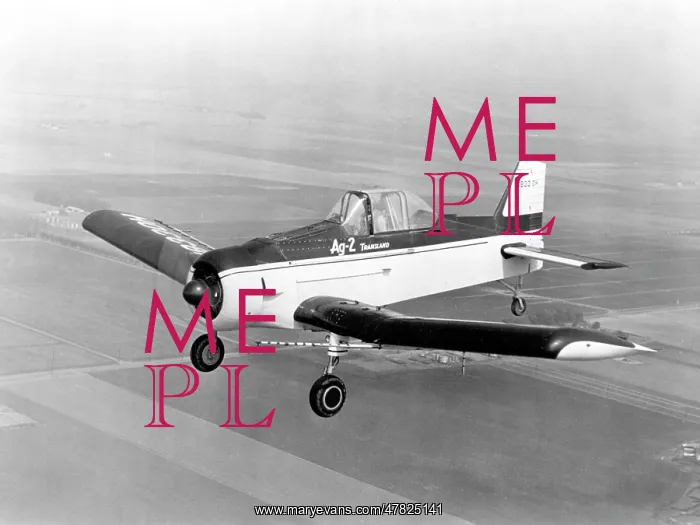
Transland Ag-2 N8330H
Transland Ag-2 N8330H, the first prototype in flight. For some years after World War II the Transland Aircraft Company of Torrance, California, a division of Hi Shear Rivet Tool Co, converted surplus World War II aircraft, particularly trainers, for the crop-dusting role. After World War II Frederick E Weick took up teaching at the Texas A and M University and designed a monoplane crop-duster as a class-room project. In 1950, in conjunction with the college, he designed the Ercoupe, and also designed and developed the AG-1, which was built in Texas as the Piper Pawnee. The prototype Ag-2 (N8330H) was first flown at Torrance on 11 October 1956 with a 336 kw (450 hp) Pratt and Whitney R-985 Wasp Junior radial engine and test flying was performed on this machine. The second aircraft (N8331H) was fitted with a 448 kw (600 hp) Pratt and Whitney R-1340 to increase payload to 1, 588 kg (3, 500 lb), the Type Certificate being awarded on 24 June 1958. A third (N8232H) machine was built in 1959 in Panama. However, this aircraft crashed and was destroyed whilst spraying bananas in Panama on 5 August 1963. In 2003 N8330H was exported to New Zealand from Uruguay and is now in a private agricultural aircraft museum