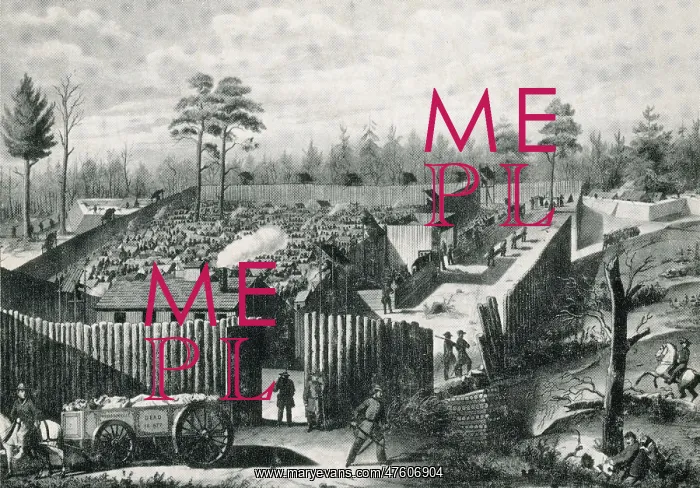


 : Andersonville Prison, Georgia


Andersonville Prison, Georgia

Andersonville Prison, officially known as Camp Sumter, was built in 1864 when Confederate officials decided to move Federal prisoners in and around Richmond to a place of greater security and more abundant food. Andersonville held more prisoners at any given time than any of the other Confederate military prisons. During the 14 months it existed, more than 45, 000 Union soldiers were confined here. Of these, almost 13, 000 died from disease, poor sanitation, malnutrition, overcrowding, or exposure to the elements. The prison covered 26 1/2 acres and was surrounded by a stockade of pine logs from 15 to 17 feet in height. Sentry boxes stood at 90-foot intervals along the top of the stockade. Once inside, 19 feet from the exterior wall, was the deadline The it was intended to prevent prisoners from climbing over the stockade or from tunneling under it. Guards had orders to shoot any prisoner who crossed the fence, or even reached over it

Picture No
10801243
Media ID
47606904
Size
4016px x 2797px (7.5MB)
Credit
©Photo Researchers / Mary Evans Picture Library
Source
Photo Researchers

Pick your License

Please tell us the book title or ISBN

Please supply intended use


Restrictions Only for Ireland and United Kingdom

Andersonville Confederacy Confederate Confine Confined Elements Exposure Imprisoned Malnutrition Notorious Overcrowding Sanitation Secession


Features In These Collections

> Contributors > PHR
Gallery Wall Inspiration

Ilya Ilyich Mechnikov, Russian Immunologist
Laughing Gas, Nitrous Oxide
James Watt, Scottish Inventor and Engineer
Asteriornis ancient bird, illustration
Hesperornis ancient bird, illustration
Icthyornis ancient bird, illustration
Confuciusornis sanctus ancient bird, illustration
Deinonychus ancient bird art, illustration
Laughing Gas, Nitrous Oxide
Thames Water Drop, 1850
Michael Faraday and Father Thames, 1855
Thames Water Drop, 1850
Michael Faraday and Father Thames, 1855
Cellular Plant Tissue, Matthias Jakob Schleiden, 1847
Henry Maudsley, British Psychiatrist
Swimming Manual, Digby, 1587
Russian Pirates, 1805
Ilya Ilyich Mechnikov, Russian Immunologist
Johnny Appleseed, American Nurseryman
Saint Paul, Christian Apostle
James Fenimore Cooper, American Author
Arthrobotrys, SEM
Rhizopus sexualis, SEM
Flint Hatchet, Stone Age Tool


© Copyright Mary Evans Picture Library - All Rights Reserved 2026
Powered by Media Storehouse®
We accept all major payment options so you can pay for the things you need in the way that is most convenient for you
Facebook     Twitter     Instagram