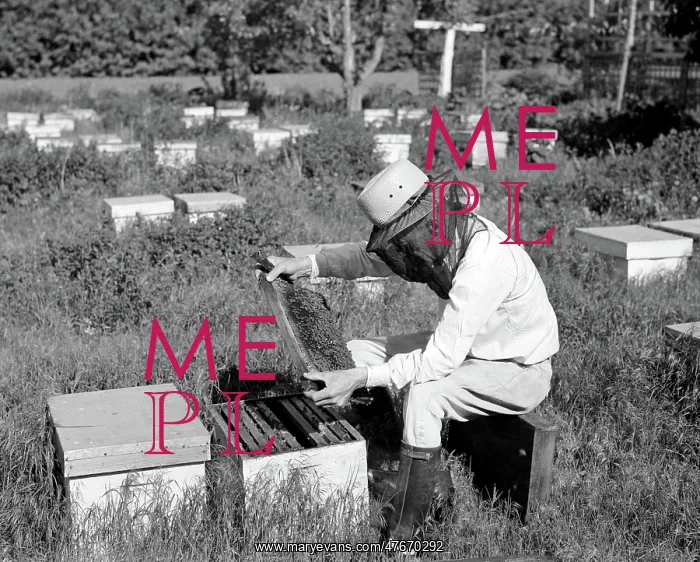
Apiary, Beekeeper Examines Honeycomb, 1940
Donald Gill, Cache County, Utah beekeeper needed bees, sugar and equipment to weather a series of bad seasons caused by weather conditions. A Farm Security Administration rehabilitation loan put him on his feet again. There are three main types of modern hive in common use worldwide: Langstroth hive, Top-bar hive, and the Warrce hive. The key innovation of the Langstroth hive was the use of vertically hanging frames on which bees build their comb. The Top-bar hive is so named because the bees draw their comb from a top bar suspended across the top of a cavity and not inside a full rectangular frame with sides and a bottom bar. The Warrce hive is a modular and storied design similar to a Langstroth hive. The hive body is made of boxes stacked vertically however, it uses top bars for comb support instead of full frames similar to a Top-Bar Hive, as a general rule. Beekeeping is the maintenance of honey bee colonies, commonly in hives, by humans. A beekeeper keeps bees in order to collect honey and other products of the hive (including beeswax, propolis, pollen, and royal jelly), to pollinate crops, or to produce bees for sale to other beekeepers. A location where bees are kept is called an apiary. Honey is a sweet food made by bees using nectar from flowers. Beekeeping practices encourage overproduction of honey so the excess can be taken from the colony. U.S. Farm Security Administration/Office of War Information, 1940
Pick your License
Restrictions Only for Ireland and United Kingdom
Apiarist Apiary Apicology Apiculture Beehive Beekeeper Beekeeping Colonies Hive Honey Honeybee Honeycomb Keeper Keeping Management Melittology Pollination Utah
Features In These Collections
> Contributors > PHR