Apollo 11 Recovery, 1969
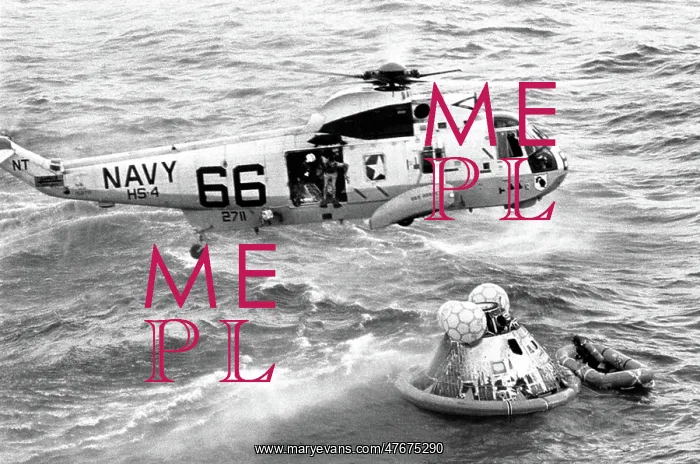
Once Columbia was upright, UDT Swim Team 2 deployed from their Sea King helicopter. They attached a sea anchor to slow the drift rate of the CM, and a flotation collar to stabilize the rocking spacecraft and two rafts to be used as work places. Helicopter, 66 dipped low near the water to allow the decontamination swimmer LTJG Clancy Hatleberg to jump from the cargo hatch. Recovery operation of the capsule in the Pacific Ocean after splashdown. Navy para-rescue men recovered the capsule housing the 3-man Apollo 11 crew. The crew was taken to safety aboard the USS Hornet, where they were quartered in a mobile quarantine facility. With the success of Apollo 11, the national objective to land men on the Moon and return them safely to Earth had been accomplished. Apollo 11 was the spaceflight that landed the first two people on the Moon. Commander Neil Armstrong and lunar module pilot Buzz Aldrin landed the Apollo Lunar Module Eagle on July 20, 1969. Armstrong became the first person to step onto the lunar surface six hours later on July 21; Aldrin joined him 19 minutes later. They spent about two hours together outside the spacecraft, and collected 47.5 pounds of lunar material to bring back to Earth. Command module pilot Michael Collins flew the command module Columbia alone in lunar orbit while they were on the Moon's surface. Armstrong and Aldrin spent 21.5 hours on the lunar surface before rejoining Columbia in lunar orbit
Pick your License
Restrictions Only for Ireland and United Kingdom
Apollo11 Crewed Demolition Eleven Lunar Manned Missions Module Nasa Para-rescue Post-flight Recovery Space-flight Spacecraft Spaceflight Splashdown
Features In These Collections
> Contributors > PHR