
Archimedes, Ancient Greek Polymath
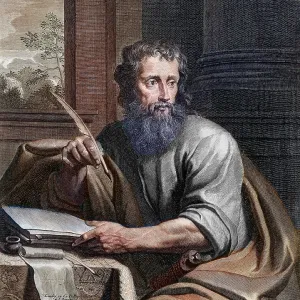
Archimedes of Syracuse (287-212 BC) was a Greek mathematician, physicist, engineer, inventor, and astronomer. Few details of his life are known, but he is regarded as one of the leading scientists in classical antiquity. Among his advances in physics are the foundations of hydrostatics, statics and an explanation of the principle of the lever. He is credited with designing innovative machines, including siege engines and the screw pump that bears his name. Archimedes is considered to be the greatest mathematician of antiquity and one of the greatest of all time. He used the method of exhaustion to calculate the area under the arc of a parabola with the summation of an infinite series, gave an accurate approximation of pi and defined the formulae for the volumes of surfaces of revolution and an ingenious system for expressing very large numbers. Archimedes died during the Siege of Syracuse when he was killed by a Roman soldier despite orders that he should not be harmed
Pick your License
Restrictions Only for Ireland and United Kingdom
Anciens Approximation Archimedes Astronomer Exhaustion Innovative Levers Math Mechanics Method Parabola Polymath Principle Screw Surfaces Syracuse Volumes
Features In These Collections
> Contributors > PHR