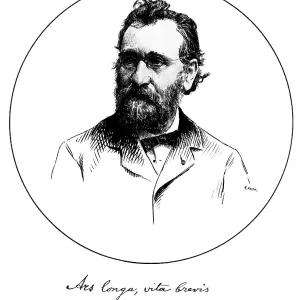
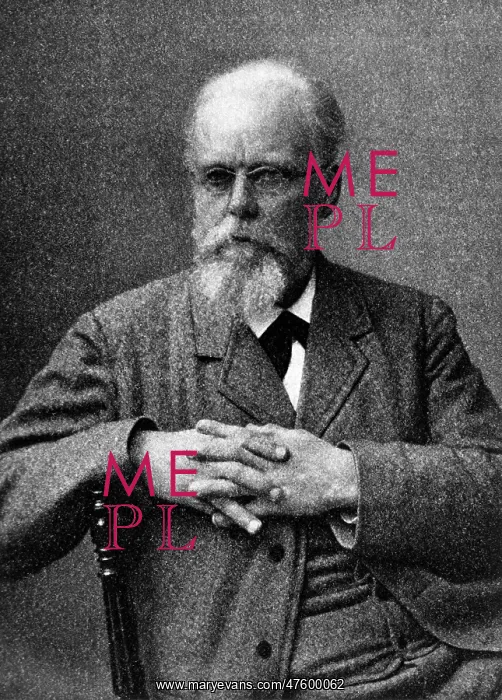
August Weismann, German Evolutionary Biologist
Friedrich Leopold August Weismann (1834-1914) was a German evolutionary biologist. Weismann worked on the embryology of sea urchin eggs, and in the course of this observed different kinds of cell division, namely equatorial division and reductional division, terms he coined. His main contribution was the germ plasm theory. He believed that in a multicellular organism inheritance only takes place by means of the germ cells (gametes such as egg cells and sperm cells). Other cells of the body (somatic cells) do not function as agents of heredity. Germ cells produce somatic cells and are not affected by anything the somatic cells learn or therefore any ability the body acquires during its life. This principle, called the Weismann barrier, states that hereditary information moves only from genes to body cells, and never in reverse. He conducted an experiment where he removed the tails of 68 white mice, repeatedly over 5 generations, and reported that no mice were born in consequence without a tail or even with a shorter tail. Weismann's ideas preceded the rediscovery of Gregor Mendel's work and were central to the Modern evolutionary synthesis (union of ideas from several biological specialties which provides a widely accepted account of evolution). He died in 1914 at the age of 80
Pick your License
Restrictions Only for Ireland and United Kingdom
1834 Barrier Biologist Biology Cells Coined Eggs Embryology Equatorial Evolutionary Evolutionist Genes Germ Hereditary Moves Observed Synthesis Theory Urchin Weismann
Features In These Collections
> Contributors > PHR