

 : Battering Rams, Ancient Roman Warfare


Battering Rams, Ancient Roman Warfare

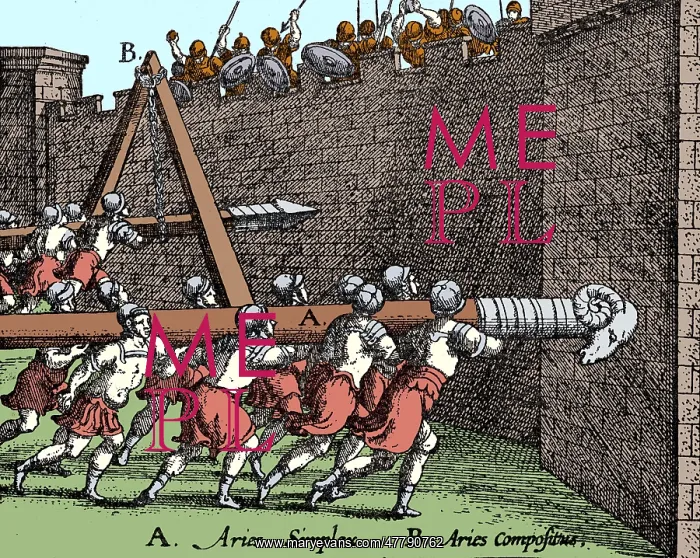
Colored illustration of The Battering Ram in Ancient Roman Warfare. This is the earliest, simplest, most effective device for destroying stone walls and the ordinary defenses of fortified towns. The primitive ram was a huge beam of seasoned and tough wood, hoisted on the shoulders of men. Running with it at full speed against a wall, gate, or palisade, they did what damage they could with one charge after another. Ancient armies used two different kinds of battering ram, one type was suspended and swinging, like a pendulum, and the other moved on rollers. Battering rams had an important effect on the evolution of defensive walls, which were constructed ever more ingeniously in a bid to nullify the effects of siege engines. Historical instances of the usage of battering rams in sieges of major cities include: destruction of Jerusalem by the Romans, the Crusades, the fall of Rome and the siege of Constantinople

Picture No
13346852
Media ID
47790762
Size
3592px x 2864px (6.6MB)
Credit
© Science Source / Mary Evans Picture Library
Usage Restrictions
Commercial sales may require 3rd party clearance
Source
Science Source

Pick your License

Please tell us the book title or ISBN

Please supply intended use


Restrictions Only for Ireland and United Kingdom

Battering Besiege Effective Walled


Features In These Collections

> Contributors > PHR

Gallery Wall Inspiration

Ilya Ilyich Mechnikov, Russian Immunologist
Laughing Gas, Nitrous Oxide
James Watt, Scottish Inventor and Engineer
Asteriornis ancient bird, illustration
Hesperornis ancient bird, illustration
Icthyornis ancient bird, illustration
Confuciusornis sanctus ancient bird, illustration
Deinonychus ancient bird art, illustration
Laughing Gas, Nitrous Oxide
Thames Water Drop, 1850
Michael Faraday and Father Thames, 1855
Thames Water Drop, 1850
Michael Faraday and Father Thames, 1855
Cellular Plant Tissue, Matthias Jakob Schleiden, 1847
Henry Maudsley, British Psychiatrist
Swimming Manual, Digby, 1587
Russian Pirates, 1805
Ilya Ilyich Mechnikov, Russian Immunologist
Johnny Appleseed, American Nurseryman
Saint Paul, Christian Apostle
James Fenimore Cooper, American Author
Arthrobotrys, SEM
Rhizopus sexualis, SEM
Flint Hatchet, Stone Age Tool


© Copyright Mary Evans Picture Library - All Rights Reserved 2026
Powered by Media Storehouse®
We accept all major payment options so you can pay for the things you need in the way that is most convenient for you
Facebook     Twitter     Instagram