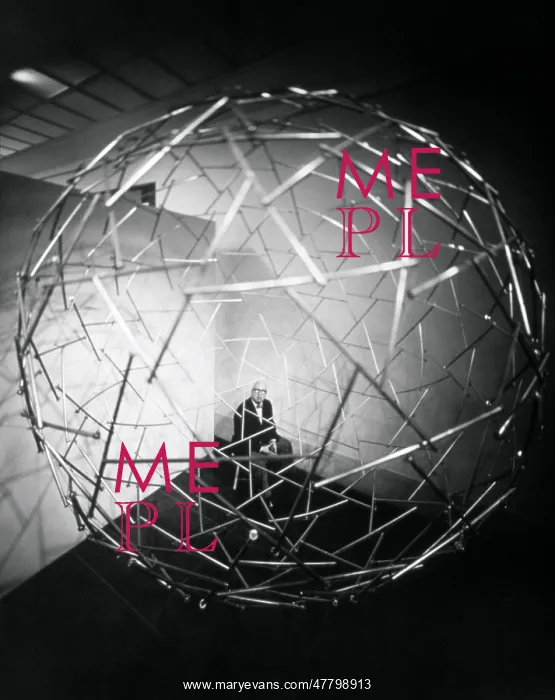
Buckminster Fuller with Geodesic Dome
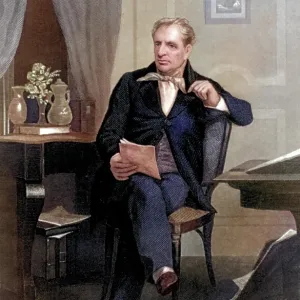
Richard Buckminster Fuller (July 12, 1895 - July 1, 1983) photographed in 1959 through a geodesic dome - a tensegrity hemisphere of 75 aluminum alloy struts and Monel wires at the Metropolitan Museum of Art in New York. This polyhedron based design structure was used to create the U.S. Pavilion at the World Expo in 1967 in Montreal, Canada. Buckminster Bucky Fuller was an American systems theorist, architect, engineer, author, designer, inventor, and futurist. He began studying at Harvard University, but was expelled twice: first for spending all his money partying with a vaudeville troupe, and then for his irresponsibility and lack of interest. By his own appraisal, he was a non-conforming misfit in the fraternity environment. He served in the US Navy in World War I, as a shipboard radio operator, and crash rescue boat commander. For the next half century, he developed many ideas, designs and inventions, particularly regarding practical, inexpensive shelter and transportation. He published more than 30 books, inventing and popularizing terms such as Spaceship Earth, ephemeralization, and synergetic. He is best known for his design of the geodesic dome. Carbon molecules known as fullerenes were later named by scientists for their resemblance to geodesic spheres. In 1983 he suffered a heart attack while visiting his wife in a Los Angeles hospital, who was dying of cancer. He died an hour later, at the of age 87, and his wife of 66 years died 36 hours later
Pick your License
Restrictions Only for Ireland and United Kingdom
Buckminster Bucky Compression Fuller Geodesic Integrity Sphere
Features In These Collections
> Contributors > PHR