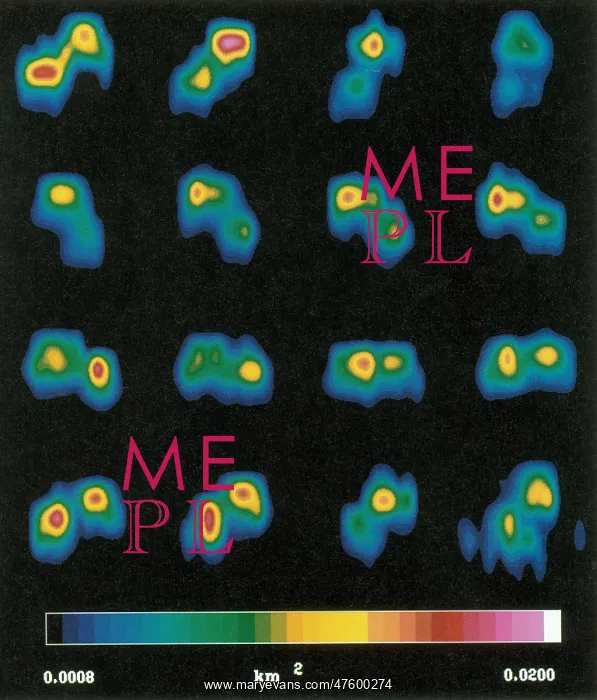
Castalia Asteroid Sequence, False-Color Coding, 1989
Castalia's orbit took it within eleven lunar distances of Earth, allowing it to be observed with radar from the Arecibo Observatory. Astronomers obtained this sequence of images by the technique of radar astronomy. The asteroid appears to be tumbling send over end as it moves through space. Castalia has a dumbbell or peanut shape and is about 1.1 miles across at its widest. Its two distinct lobes are about.47 miles across. It has a narrow waist of approximately 330 to 490 feet in depth. The two lobes were probably separate objects that came together after a relatively gentle collision. Radar astronomy is the branch of astronomy that uses radar to map the surfaces of planetary bodies and to determine periods of rotation
Pick your License
Restrictions Only for Ireland and United Kingdom
Asteroid Astronomical Castalia Celestial Coding Dumb Dumbbell Heavenly Luminous Mapping Observatory Observed Peanut Periods Planetary Planetoid Planets Radar Rotation Sequence Surfaces Tumbling Wandering
Features In These Collections
> Contributors > PHR