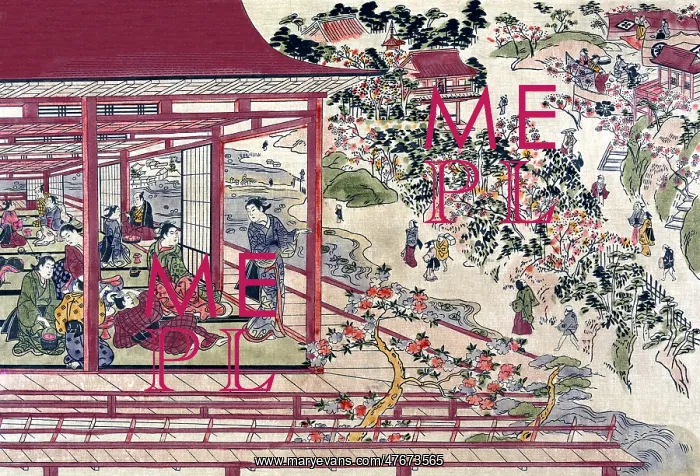
Cherry Blossom Viewing at Ueno, 18th Century
Ueno ikenohata sakura no hanami no kei. Print shows many people in a pavilion and in Ueno Park viewing blossoms on cherry trees. A cherry blossom (commonly known in Japan as sakura) is the flower of any of several trees of genus Prunus, particularly the Japanese cherry, Prunus serrulata. In Japan, cherry blossoms symbolize clouds due to their nature of blooming en masse, besides being an enduring metaphor for the ephemeral nature of life, an aspect of Japanese cultural tradition that is often associated with Buddhist influence, and which is embodied in the concept of mono no aware. The association of the cherry blossom with mono no aware dates back to 18th century scholar Motoori Norinaga. The transience of the blossoms, the exquisite beauty and volatility, has often been associated with mortality and graceful and readily acceptance of destiny and karma; for this reason, cherry blossoms are richly symbolic, and have been utilized often in Japanese art, manga, anime, and film. Along with the chrysanthemum, the cherry blossom is considered the national flower of Japan. Nishimura Shigenaga, 1725
Pick your License
Restrictions Only for Ireland and United Kingdom
1700s 1720s 1725 Aware Cherry Destiny Eighteenth Exquisite Impermanence Karma Mono Mortality Nishimura Prunus Sakura Serrulata Symbolical Symbolism Transience Ueno Ukiyo-e Volatility Wabi-sabi Woodblock
Features In These Collections
> Contributors > PHR