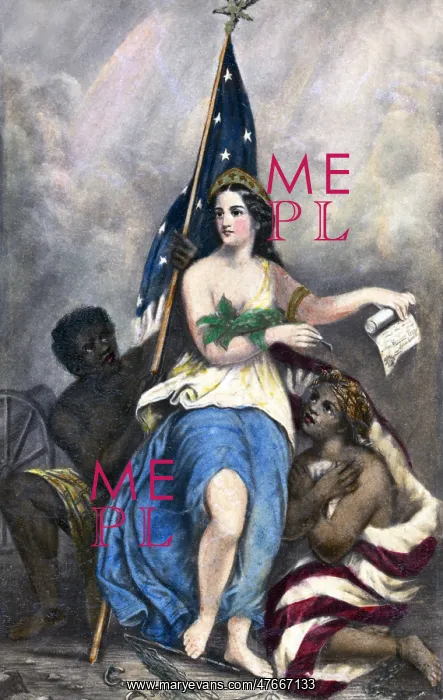
Columbia Holding Emancipation Proclamation, 1863
A woman (Columbia) holding the Emancipation Proclamation and standing between two kneeling slaves. The slave to her left, a man, holds a U.S. flag; the slave to her right, a woman, is draped in the U.S. flag. The Emancipation Proclamation was a presidential proclamation and executive order issued by President Abraham Lincoln on January 1, 1863. It proclaimed the freedom of slaves in the ten states that were still in rebellion. The Proclamation was based on the president's constitutional authority as commander in chief of the armed forces; it was not a law passed by Congress. The Proclamation did not compensate the owners, did not outlaw slavery, and did not grant citizenship to the ex-slaves (called freedmen). It made the eradication of slavery an explicit war goal, in addition to the goal of reuniting the Union. Columbia is a historical and poetic name used for the United States of America. Columbia was largely displaced as the female symbol of the U.S. by the Statue of Liberty around 1920. Art attributed to G.G. Fish, 1863
Pick your License
Restrictions Only for Ireland and United Kingdom
Abolition Abolitionist Anti-slavery Antislavery Campaigner Chattel Contraband Contrabands Crusader Emancipated Emancipation Escaped Fugitive Negro Negroes Proclamation Runaway Secession Slaves
Features In These Collections
> Contributors > PHR