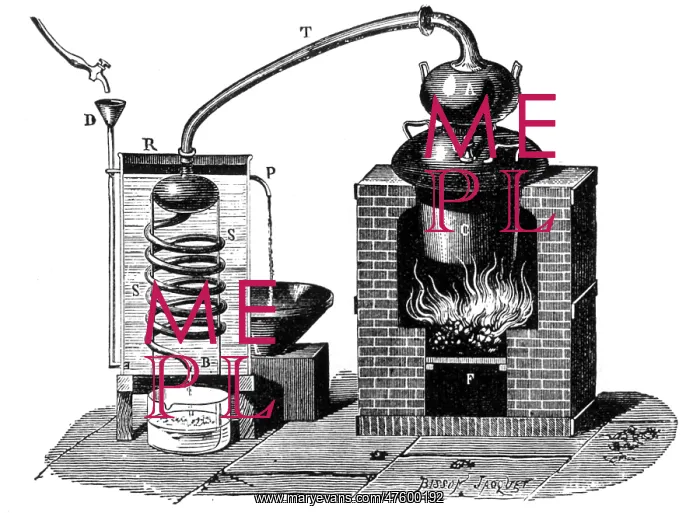
Distillation By Means of A Metallic Still, 1892
Illustration from an 1892 Chemistry book for distillation by means of a metallic still. Retort and attachments sits on a furnace; neck is connected to coils immersed in a container (cutaway for view) of cold water. The liquid in C is heated by the fire F. The vapors rise through the head A and pass by the tube T to the worms placed in a vessel through which a current of cold water flows by means of tubes D and P. In chemistry, distillation means the separating of the constituents of a liquid by boiling it and then condensing the vapor that results. Distillation can be used to purify water or other substances, or to remove one component from a complex mixture, as when gasoline is distilled from crude oil or alcohol from a mash. When water is purified by distillation, it is boiled in a container, and the steam is sent into cooling tubes. The steam is condensed and then collected as purified water in a second container. The impurities in the water are left behind in the first container and can be discarded
Pick your License
Restrictions Only for Ireland and United Kingdom
Chemical Chemistry Distillate Distillation Purification Refining
Features In These Collections
> Contributors > PHR