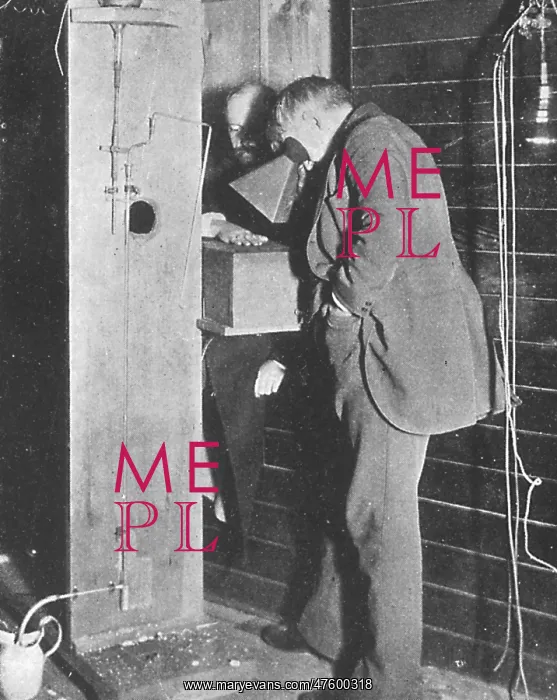
Edison Fluoroscope, 1896
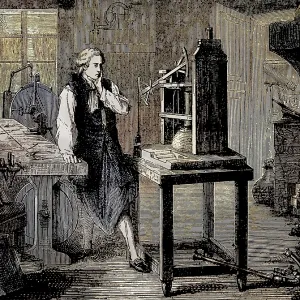
Thomas Edison examines Clarence Dally's, his assistant, hand thru a fluoroscope of his own design. Edison began a series of x-ray experiments immediately on learning of Roentgen's discovery. He tested hundreds of luminescent substances before choosing the most effective. The main apparatus, left, is a Sprengel vacuum pump. A fluoroscope is a radiologic instrument equipped with a fluorescent screen on which opaque internal structures can be viewed as moving shadow images formed by the differential transmission of x-rays through the body. Thomas Alva Edison (1847-1931) who was an American inventor, famous for inventing or improving devices such as the phonograph and the electric light bulb. Edison was one of the first inventors to build research laboratories to make and develop inventions. He also founded several companies, and filed over 1000 patents. Other work included improvements to telegraphy, cameras, and motion picture cameras, as well as promoting his DC electrical distribution systems. He also discovered the Edison Effect, on which thermionic valves are based
Pick your License
Restrictions Only for Ireland and United Kingdom
1847 Alva Battery Dally Diagnostic Edison Examines Experimented Imaging Internal Invasive Invented Mechanical Non Invasive Non-invasive Observes Opaque Phonograph Procedure Radiogram Radiography Radiology Recorder Scan Structures Tested Ticker Tomogram Tomography Vacuum X Ray X-ray Xray
Features In These Collections
> Contributors > PHR