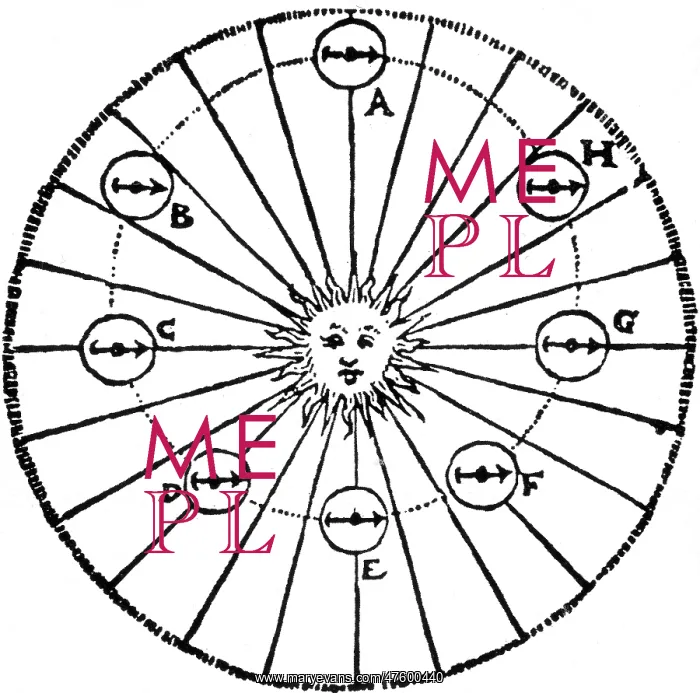
Epitome Astronomiae Copernicanae, 1619
Kepler's concept of an attractive force from the Sun - a virtue, early 16th century. His idea of gravity by which he hoped to account for his elliptical planetary orbits. Planets, moons and stars were rotating magnets and their magnetism maintained planet orbits with forcefield-thread vortexes acting mechanically. Image from Epitome Astronomiae Copernicanae. Johannes Kepler (1571-1630) was a German mathematician, astronomer and astrologer. A key figure in the 17th century scientific revolution, he is best known for his laws of planetary motion based on his works Astronomia nova, Harmonices Mundi, Epitome Astronomiae Copernicanae. These works also provided one of the foundations for Isaac Newton's theory of universal gravitation
Pick your License
Restrictions Only for Ireland and United Kingdom
1571 1630 Astrologist Astrology Astronomer Astronomia Astronomiae Closer Elliptical Epitome Faster Fundamental Harmonices Johannes Kepler Laws Magnet Magnetism Mathematician Mathematics Moves Mundi Nova Orbit Orbital Orbits Paths Planetary Planets Rotating Rotation
Features In These Collections
> Contributors > PHR