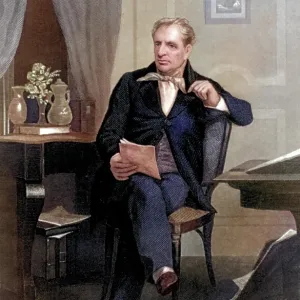

Frederick Soddy, English Radiochemist
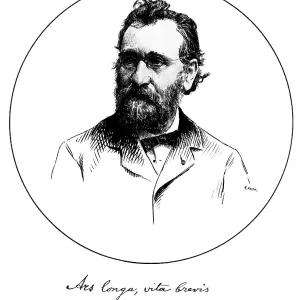
Frederick Soddy (1877-1956) was an English radiochemist and monetary economist. In 1900 he became a demonstrator in chemistry at McGill University in Quebec, where he worked with Ernest Rutherford on radioactivity. When radioactivity was first discovered, no one was sure what the cause was. It needed careful work by Soddy and Rutherford to prove that atomic transmutation was in fact occurring. In 1903, Soddy verified that the decay of radium produced alpha particles composed of positively charged nuclei of helium. From 1904 to 1914, Soddy was a lecturer at the University of Glasgow and while there he showed that uranium decays to radium. It was here also that he showed that a radioactive element may have more than one atomic mass though the chemical properties are identical. He named this concept isotope. He received the 1921 Nobel Prize in chemistry for his research in radioactive decay and particularly for his formulation of the theory of isotopes. He died in 1956 at the age of 79. The lunar crater Soddy is named after him, as is the uranium compound Soddyite
Pick your License
Restrictions Only for Ireland and United Kingdom
1877 Alpha Atomic Coined Compound Decay Economist Isotope Isotopes Laureate Monetary Nobelist Particles Radiation Radioactive Radioactivity Radiochemist Radiochemistry Radium Recipient Rutherford Studied Term Theory Transmutation Uranium
Features In These Collections
> Contributors > PHR