

 : Freedmen's Bureau, 1868


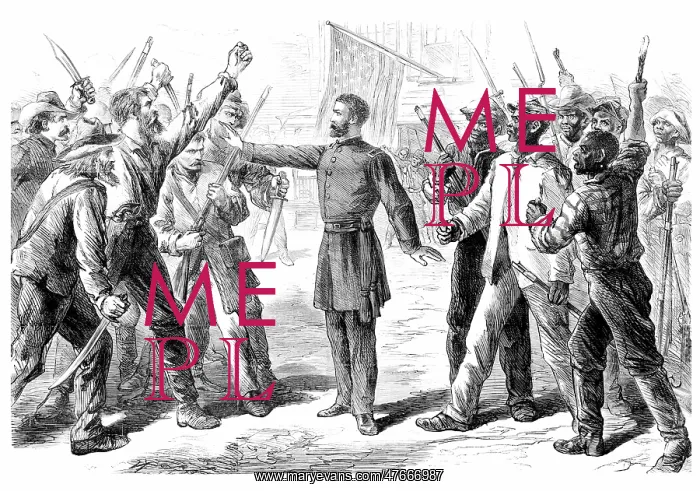
Freedmen's Bureau, 1868

Man representing the Freedman's Bureau stands between armed groups of Euro-Americans and Afro-Americans. In the United States, the terms freedmen and freedwomen refer to former slaves emancipated during and after the American Civil War, by the Emancipation Proclamation and the 13th Amendment. To help freedmen transition from slavery to freedom, President Abraham Lincoln created the Freedmen's Bureau, which assigned agents throughout the former Confederate states. The Freedmen's Bureau helped African-Americans find family members from whom they had become separated during the war. The Bureau also founded schools to educate freedmen, both adults and children. The Bureau encouraged former major planters to rebuild their plantations and urged freed blacks to return to work for them, kept an eye on contracts between the newly free laborers and planters, and pushed whites and blacks to work together as employers and employees rather than as masters and slaves. Engraving by Alfred Rudolph Waud for Harper's Weekly, July 25, 1868

Picture No
12695888
Media ID
47666987
Size
4500px x 3153px (4.7MB)
Credit
LOC/Science Source/Mary Evans

Pick your License

Please tell us the book title or ISBN

Please supply intended use


Restrictions Only for Ireland and United Kingdom

Arbitrator Bureau Chattel Contraband Contrabands Emancipated Escaped Freedmen Freedmens Fugitive Harpers Negro Negroes Runaway Secession Slaves Weekly


Features In These Collections

> Contributors > PHR
Gallery Wall Inspiration

Ilya Ilyich Mechnikov, Russian Immunologist
Laughing Gas, Nitrous Oxide
James Watt, Scottish Inventor and Engineer
Asteriornis ancient bird, illustration
Hesperornis ancient bird, illustration
Icthyornis ancient bird, illustration
Confuciusornis sanctus ancient bird, illustration
Deinonychus ancient bird art, illustration
Laughing Gas, Nitrous Oxide
Thames Water Drop, 1850
Michael Faraday and Father Thames, 1855
Thames Water Drop, 1850
Michael Faraday and Father Thames, 1855
Cellular Plant Tissue, Matthias Jakob Schleiden, 1847
Henry Maudsley, British Psychiatrist
Swimming Manual, Digby, 1587
Russian Pirates, 1805
Ilya Ilyich Mechnikov, Russian Immunologist
Johnny Appleseed, American Nurseryman
Saint Paul, Christian Apostle
James Fenimore Cooper, American Author
Arthrobotrys, SEM
Rhizopus sexualis, SEM
Flint Hatchet, Stone Age Tool


© Copyright Mary Evans Picture Library - All Rights Reserved 2026
Powered by Media Storehouse®
We accept all major payment options so you can pay for the things you need in the way that is most convenient for you
Facebook     Twitter     Instagram