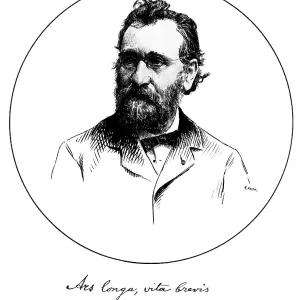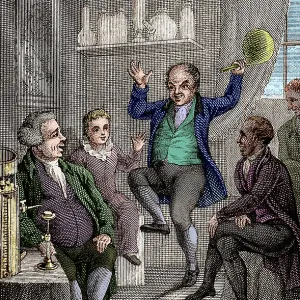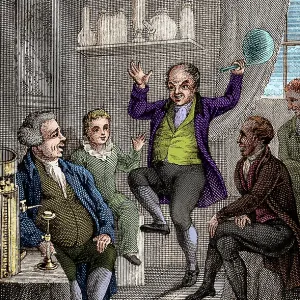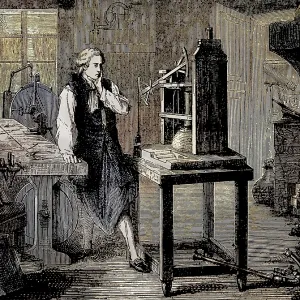

Gay-Lussac and Jean-Baptiste Biot, 1804
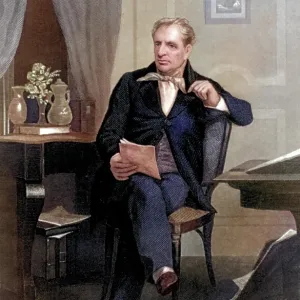
Gay-Lussac in a daring 1804 balloon ascent to investigate terrestrial magnetism and the composition of air at high altitude. Joseph Louis Gay-Lussac (1778-1850) was a French chemist and physicist known for his studies on the physical properties of gases. His first major investigation concerned the thermal expansion of gases. He showed that a common thermal-expansion coefficient applied to all gases. This was significant in the establishment of the Kelvin temperature scale later in the century. 1804, Gay-Lussac and Jean-Baptiste Biot ascended to a height of approximately 13, 000 feet to study variations in the Earth's electro-magnetic intensity relative to altitude. In a later solo ascent, he climbed to 23, 000 feet (a record held for fifty years) and experienced the effects of oxygen deprivation but still managed to collect air samples, study the variation of pressure and temperature, and repeat his earlier electro-magnetic observations. In 1805, he collaborated with Alexander von Humboldt in determining the proportions of hydrogen and oxygen present in water. In 1810 he published a paper which contains some classic experiments on fermentation. His last great piece of pure research was on prussic acid in 1815 when he described cyanogen as a compound radicle, prussic acid as a compound of that radicle with hydrogen alone, and the prusiates (cyanides) as compounds of the radicle with metals. The proof that prussic acid contains hydrogen but no oxygen was an important support to the hydrogen-acid theory. He died in 1850 at the age of 71
Pick your License
Restrictions Only for Ireland and United Kingdom
1778 1804 1805 1810 1815 Acid Baptiste Biot Boron Chemistry Collaborated Combing Eiffel Electro Electro-magnetic Element Expansion Experimented Fermentation Gases Gay-lussac Humboldt Hydrogen Investigated Isolated Jean Baptiste Jean-baptiste Lussac Magnetic Observations Oxygen Pressure Properties Proportions Prussic Researched Studied Temperature Thénard Thermal Variation Volumes
Features In These Collections
> Contributors > PHR