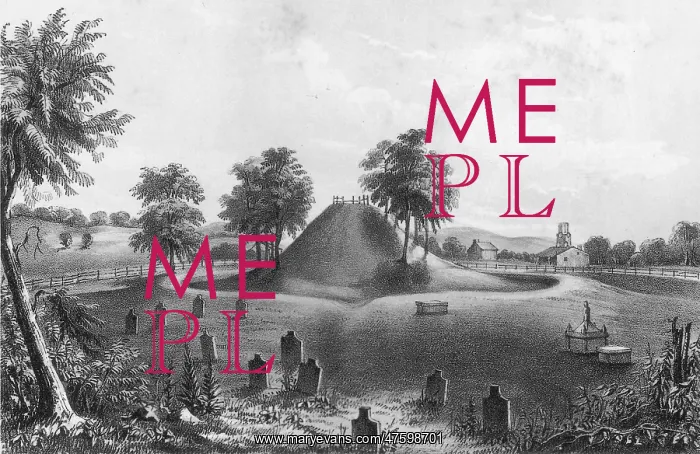


 : Great Mound at Marietta, 1848


Great Mound at Marietta, 1848

Mound building was a central feature of the public architecture of many Native American and Mesoamerican cultures from Chile to Minnesota. Thousands of mounds in America have been destroyed as a result of farming, pot-hunting, amateur and professional archaeology, road-building and construction. Surviving mounds are still found in river valleys, especially along the Mississippi, Tennessee and Ohio Rivers, and as far west as Spiro Mounds in Oklahoma. Mounds were used for burial, to support residential and religious structures, to represent a shared cosmology, and to unite and demarcate community. Common forms include conical mounds, ridge-top mounds, platform mounds, and animal effigy mounds, but there are many variations. Mound building in America is believed to date back to at least 3400 BC in the Southeast. The Adena and the Mississippian cultures are principally known for their mounds, as is the Hopewell tradition. This illustration appeared in Ephraim George Squier and Edwin Davis book, Ancient Monuments of the Mississippi Valley, 1848. Together they were responsible for the excavations of some 200 prehistoric Indian mounds

Picture No
10802759
Media ID
47598701
Size
3900px x 2531px (5.9MB)
Credit
©Photo Researchers / Mary Evans Picture Library
Source
Photo Researchers

Pick your License

Please tell us the book title or ISBN

Please supply intended use


Restrictions Only for Ireland and United Kingdom

Hopewell Marietta Mississippi Mound Ohio


Features In These Collections

> Contributors > PHR
Gallery Wall Inspiration

Ilya Ilyich Mechnikov, Russian Immunologist
Laughing Gas, Nitrous Oxide
James Watt, Scottish Inventor and Engineer
Asteriornis ancient bird, illustration
Hesperornis ancient bird, illustration
Icthyornis ancient bird, illustration
Confuciusornis sanctus ancient bird, illustration
Deinonychus ancient bird art, illustration
Laughing Gas, Nitrous Oxide
Thames Water Drop, 1850
Michael Faraday and Father Thames, 1855
Thames Water Drop, 1850
Michael Faraday and Father Thames, 1855
Cellular Plant Tissue, Matthias Jakob Schleiden, 1847
Henry Maudsley, British Psychiatrist
Swimming Manual, Digby, 1587
Russian Pirates, 1805
Ilya Ilyich Mechnikov, Russian Immunologist
Johnny Appleseed, American Nurseryman
Saint Paul, Christian Apostle
James Fenimore Cooper, American Author
Arthrobotrys, SEM
Rhizopus sexualis, SEM
Flint Hatchet, Stone Age Tool


© Copyright Mary Evans Picture Library - All Rights Reserved 2026
Powered by Media Storehouse®
We accept all major payment options so you can pay for the things you need in the way that is most convenient for you
Facebook     Twitter     Instagram