Harmonices Mundi, 1619
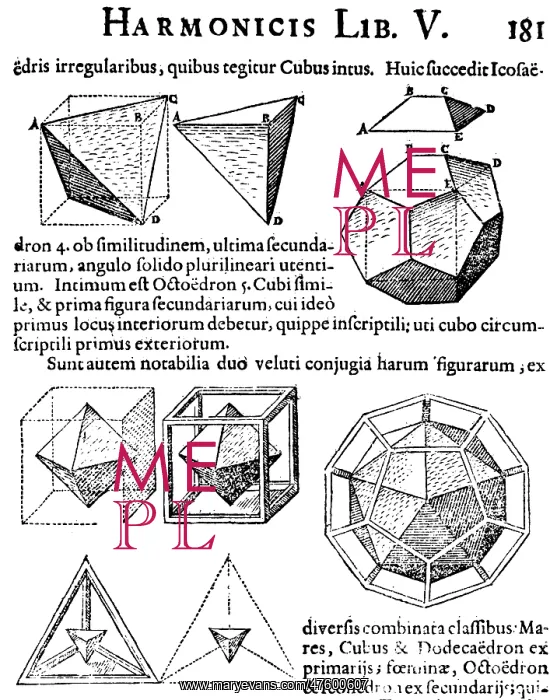
Geometric diagrams from a page of Kepler's Harmonices Mundi showing how one regular polyhedron fits inside another. He calls the cube and dodecahedron male, and the octahedron and icosahedron female, since the latter can fit inside the former, while the tetrahedron is androgynous, since it if fits in itself. Johannes Kepler (1571-1630) was a German mathematician, astronomer and astrologer. A key figure in the 17th century scientific revolution, he is best known for his works Astronomia nova, Harmonices Mundi, and Epitome Astronomiae Copernicanae. These works also provided one of the foundations for Isaac Newton's theory of universal gravitation. Kepler devised the three fundamental laws of planetary motion. These laws were based on detailed observations of the planets made by Tycho Brahe and himself. Kepler's first law states that the planets orbit the Sun in elliptical paths, with the Sun at one focus of the ellipse. The second law states that the closer a planet comes to the Sun, the faster it moves. Kepler's third law states that the ratio of the cube of a planet's mean distance from the Sun to the square of its orbital period is a constant
Pick your License
Restrictions Only for Ireland and United Kingdom
1571 1619 1630 Androgynous Astrologist Astrology Astronomer Cube Diagram Geometric Geometrical Harmonices Johannes Kepler Mathematical Mathematician Mathematics Mundi Shapes
Features In These Collections
> Contributors > PHR