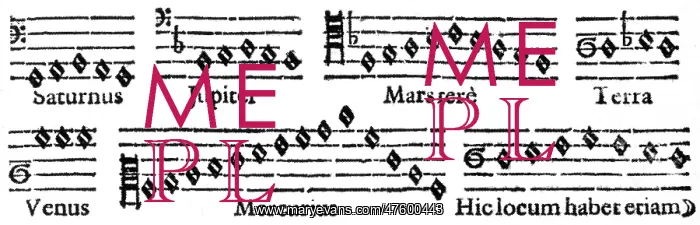


 : Harmony of the World, 1619


Harmony of the World, 1619

In Harmonices Mundi (1619) Kepler attempted to explain the harmony of the world and contained what is known today as his third law. The work was founded on geometry, from which Kepler derived first a theory of musical harmony and then a cosmology of the heavens and the earth. Kepler attempted to find common rules between music and movement in the solar system. His music of the spheres is based on the relative maximum and minimum angular velocities of the planet measured from the sun. Using his theories, Kepler allotted to the planets musical intervals and musical motion. Johannes Kepler (1571-1630) was a German mathematician, astronomer and astrologer. A key figure in the 17th century scientific revolution, he is best known for his laws of planetary motion based on his works Astronomia nova, Harmonices Mundi, and Epitome of Copernican Astronomy. These works also provided one of the foundations for Isaac Newton's theory of universal gravitation

Picture No
10801842
Media ID
47600443
Size
5529px x 1774px (2.0MB)
Credit
©Photo Researchers / Mary Evans Picture Library
Source
Photo Researchers

Pick your License

Please tell us the book title or ISBN

Please supply intended use


Restrictions Only for Ireland and United Kingdom

1571 1630 Astrologist Astrology Astronomer Astronomia Astronomiae Closer Copernican Elliptical Epitome Faster Fundamental Harmonices Johannes Kepler Laws Mathematician Mathematics Moves Mundi Nova Orbit Paths Planetary Planets


Features In These Collections

> Contributors > PHR
Gallery Wall Inspiration

Ilya Ilyich Mechnikov, Russian Immunologist
Laughing Gas, Nitrous Oxide
James Watt, Scottish Inventor and Engineer
Asteriornis ancient bird, illustration
Hesperornis ancient bird, illustration
Icthyornis ancient bird, illustration
Confuciusornis sanctus ancient bird, illustration
Deinonychus ancient bird art, illustration
Laughing Gas, Nitrous Oxide
Thames Water Drop, 1850
Michael Faraday and Father Thames, 1855
Thames Water Drop, 1850
Michael Faraday and Father Thames, 1855
Cellular Plant Tissue, Matthias Jakob Schleiden, 1847
Henry Maudsley, British Psychiatrist
Swimming Manual, Digby, 1587
Russian Pirates, 1805
Ilya Ilyich Mechnikov, Russian Immunologist
Johnny Appleseed, American Nurseryman
Saint Paul, Christian Apostle
James Fenimore Cooper, American Author
Arthrobotrys, SEM
Rhizopus sexualis, SEM
Flint Hatchet, Stone Age Tool


© Copyright Mary Evans Picture Library - All Rights Reserved 2026
Powered by Media Storehouse®
We accept all major payment options so you can pay for the things you need in the way that is most convenient for you
Facebook     Twitter     Instagram