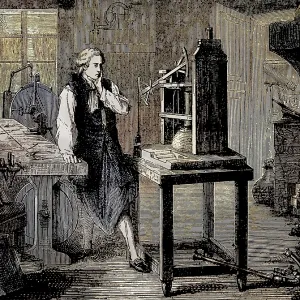
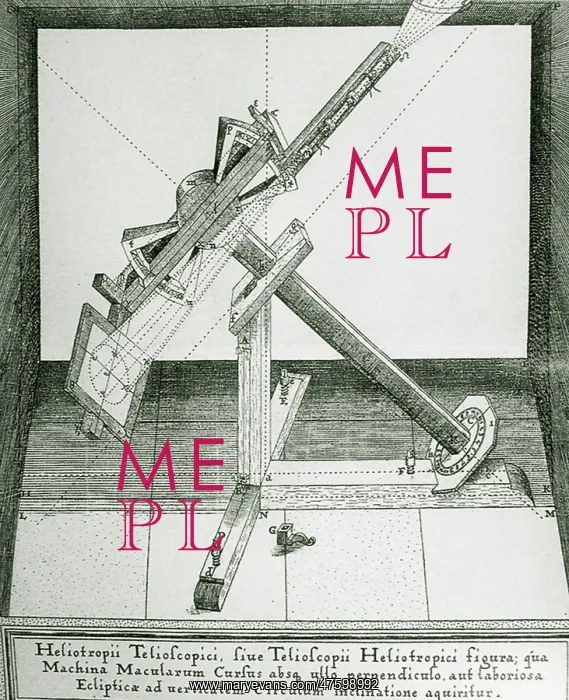
Helioscope, 17th century
Helioscope. Diagram of a helioscope, an instrument which was used for viewing the sun during the early 1600s. It works by projecting the image seen with a telescope onto a white piece of paper suspended in a darkened room. The first purpose built helioscope was designed by German astronomer Christoph Scheiner (1575-1650) to assist his sunspot observations. Sunspots are dark areas on the Sun's surface caused by fluctuating magnetic fields within the Sun. Scheiner was the co-discoverer of sunspots and published his great work, the Rosa Ursina, in the 1630s, from which this illustration was taken. It was the standard treatise on the subject for more than a century, containing numerous observations and also a detailed account of his methods and apparatus
Pick your License
Restrictions Only for Ireland and United Kingdom
1600s 1630 Astronomer Astronomical Beam Black And White Black-and-white Christoph Co-discoverer Diagram Diagrams Discoverer Mapping Pioneering Projection Researching Rosa Scheiner Studying Sunspot Sunspots Technological Telescope Treatise Ursina
Features In These Collections
> Contributors > PHR