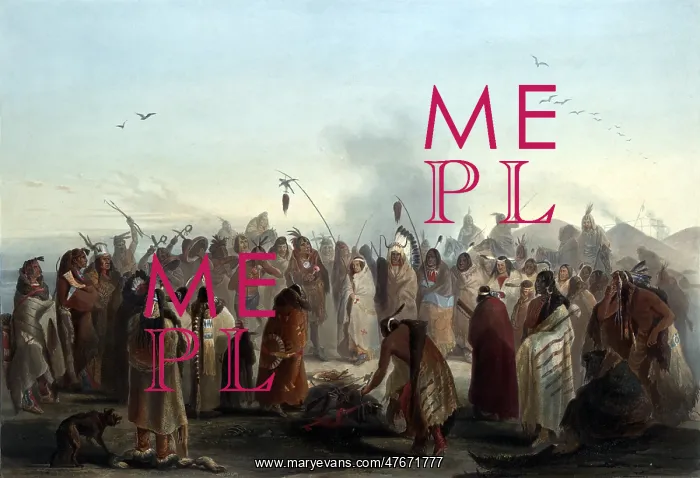
Hidatsa Indian Scalp Dance, 1830s
The Hidatsa, called the Minnetaree by the Mandan, are a Siouan people. The scalp dance, is next to the medicine dance in importance, and is the most common of all the ceremonial dances of the Indians. The day after the return to the home encampment of a successful war party, by which scalps have been taken, a ceremony is performed by the warriors who took them. Medicine men sang and beat drums while women danced in concentric circles around the scalps. Sometimes dancers would mock the scalps or mimic hunting down the person to whom the scalp had belonged. Voyage dans l'interieur de l'Amerique du Nord, execute pendant les annees 1832-34. Karl Bodmer (February 11, 1809 - October 30, 1893) was a Swiss printmaker, lithographer, painter, illustrator and hunter. He accompanied the German explorer Prince Maximilian zu Wied-Neuwied on his Missouri River expedition. Bodmer was hired as an artist to record images of cities, rivers, towns and peoples they saw along the way, including the many tribes of Native Americans along the Missouri River and in that region
Pick your License
Restrictions Only for Ireland and United Kingdom
Bodmer Ceremonies Encampment Ethnography Hidatsa Hiraacǭ Maximilian Minnetaree Missouri Plains Prairie Salvage Scalp Siouan Siouan-speaking Sioux Wied-neuweid Wied-neuwied
Features In These Collections
> Contributors > PHR