Hooke's Law, Principle of Physics, 1678
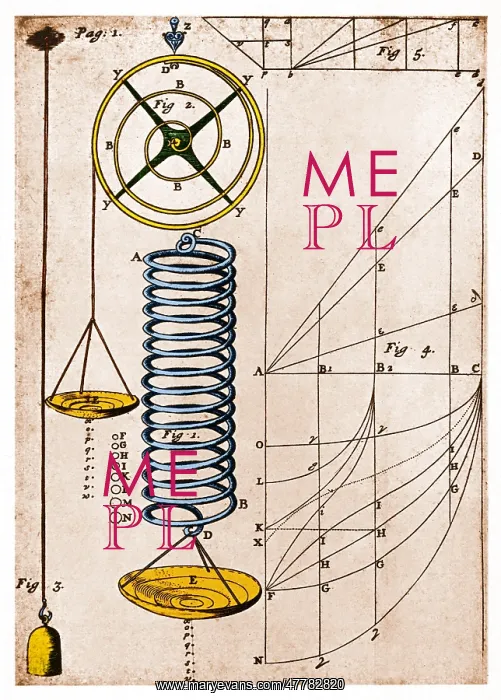
Hooke's Law, Principle of Physics, 1678. Hooke's law is a principle of physics that states that the force F needed to extend or compress a spring by some distance X is proportional to that distance. That is: F = kX, where k is a constant factor characteristic of the spring: its stiffness, and X is small compared to the total possible deformation of the spring. The law is named after 17th century English physicist Robert Hooke. He first stated the law in 1660 as a Latin anagram. He published the solution of his anagram in 1678 as: ut tensio, sic vis ('as the extension, so the force or the extension is proportional to the force')
Picture No
13344106
Media ID
47782820
Size
3407px x 4765px
(5.9MB)
Credit
© Science Source / Mary Evans Picture Library
Usage Restrictions
Commercial sales may require 3rd party clearance
Source
Science Source