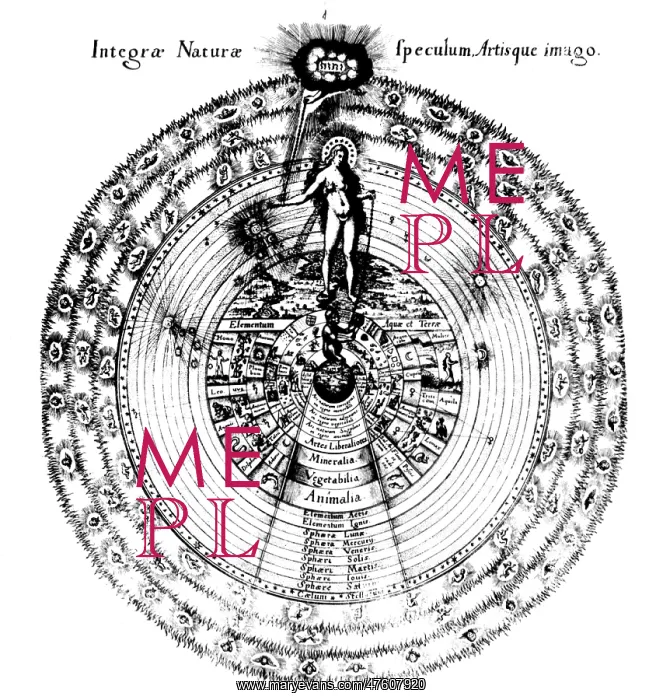
Integrae Naturae, 17th Century
During the sixteenth and seventeenth centuries, notions of macrocosm and microcosm were widely accepted. Many people believed that the same patterns are to be found in the human body (microcosm) on a small scale, as are found in the natural universe as a whole (macrocosm.) The macrocosm showing the human body as the world soul; a nude female figure is chained on the right hand to God and on the left to a monkey representing man; astrological and alchemical symbols fill inner circles; hierarchy of angels form outer circles. Robert Fludd, also known as Robertus de Fluctibus (1574-1637) was a prominent English Paracelsian physician, astrologer, mathematician, cosmologist, Qabalist, Rosicrucian apologist. His philosophy is presented in Utriusque Cosmi, Maioris scilicet et Minoris, metaphysica, physica, atque technica Historia (The metaphysical, physical, and technical history of the two worlds, namely the greater and the lesser), published in Germany between 1617 and 1621
Pick your License
Restrictions Only for Ireland and United Kingdom
1617 1621 Alchemical Alchemy Astrological Astrology Cosmology Entire Fludd Frontispiece Integra Macrocosm Metaphysical Microcosm Naturae Symbolism
Features In These Collections
> Contributors > PHR