Islamic Magic Squares, 18th Century
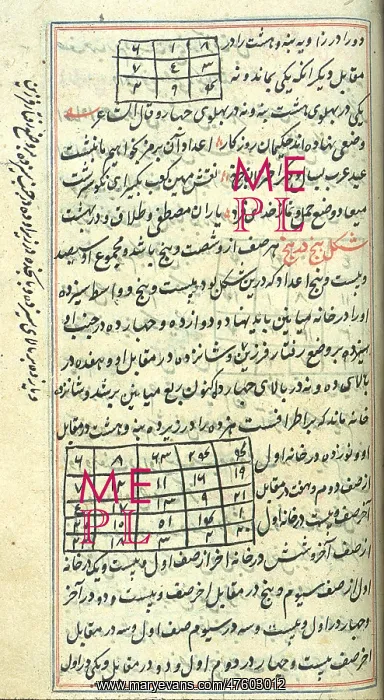
Two magic squares, the top one a 3x3 square buduh square and the lower one 5x5. From Aja'ib al-makhluqat wa-ghara'ib al-mawjudat (Marvels of Things Created and Miraculous Aspects of Things Existing) by Abu Yahya Zakariya ibn Muhammad al-Qazwini (1203-1283) an Arab physician, astronomer, geographer and proto-science fiction writer. Neither the copyist nor illustrator is named, and the copy is undated. The nature of paper, script, ink, and illustrations suggests that it was produced in western India in the 18th century. The first appearance of a magic square (known in Arabic as wafq) in Islamic literature occurs in the group of writings attributed to Jabir ibn Hayyan, known in Europe as Geber, and generally thought to have been compiled at the end of the 9th or early 10th century A.D. The magic square, given as a charm of easing childbirth in the Jabirean corpus, is thought to be of Chinese origin. It consisted of nine cells with the numbers 1 to 9 arranged with 5 in the center so that the contents of each row, column and the two diagonals added up to 15. The numbers were written in the abjad letter-numerals, and because the four corners of this square contained the letters ba, dal, waw [or u], and ha, this particular square became known as the buduh square. So popular was this magic square that the name buduh itself was assigned talismanic properties. In subsequent years Islamic writers developed a variety of methods for forming larger magic squares, in which no numeral was repeated and the sums of each row and each column and the two diagonals were the same. Magic squares with cells 4x4 or 6x6 or 7x7 were particularly popular, with 10x10 squares being produced by the 13th century. By the 19th century 100x100 magic squares, with 10, 000 individual cells, were being produced
Pick your License
Restrictions Only for Ireland and United Kingdom
Ajaib Al Makhluqat Al Mawjudat Al Qazwini Al-makhluqat Al-mawjudat Al-qazwini Arabic Aspects Charm Childbirth Easing Existing Ghara Makhluqat Marvels Mawjudat Miraculous Muhammad Origin Properties Qazwini Squares Talisman Wa-gharaib Yahya Zakariya
Features In These Collections
> Contributors > PHR