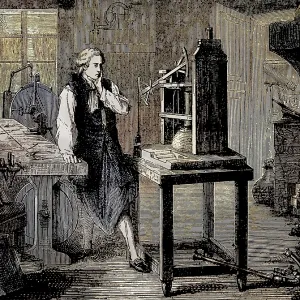
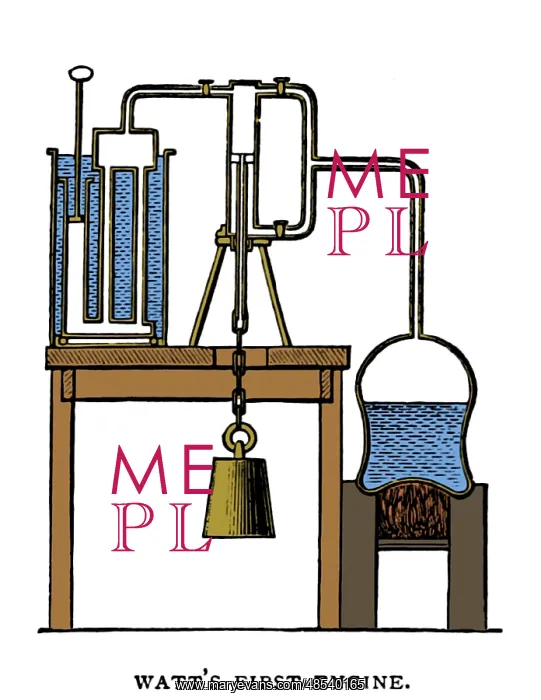
James Watt, First Steam Engine, 18th Century
Watts first steam engine illustration taken from page 114 of George Square, Glasgow; and the lives of those whom its statues commemorate, etc by Thomas (of Glascow) Somerville, 1891. The Watt steam engine (alternatively known as the Boulton and Watt steam engine) was the first type of steam engine to make use of steam at a pressure just above atmospheric to drive the piston helped by a partial vacuum. Improving on the design of the 1712 Newcomen engine, the Watt steam engine, developed sporadically from 1763 to 1775, was the next great step in the development of the steam engine. Watt's two most important improvements were the separate condenser and rotary motion. The separate condenser, located external to the cylinder, condensed steam without cooling the piston and cylinder walls as did the internal spray in Newcomen's engine, more than doubling Watt's engine's efficiency. Rotary motion was more suitable for industrial power than the oscillating beam of Newcomen's engine. James Watt's design became synonymous with steam engines, due in no small part to his business partner, Matthew Boulton. In 1785, Watt was made a Fellow of the Royal Society. He developed the concept of horsepower and the SI unit of power, the watt, was named after him. He died in 1819 at the age of 83. Watt has been described as one of the most influential figures in human history
Pick your License
Restrictions Only for Ireland and United Kingdom
1700s Bouillon Diagram Driven Efficiency Eighteenth Enhancement Piston Steam-driven Steam-powered Technological Turbine Watt
Features In These Collections
> Contributors > PHR