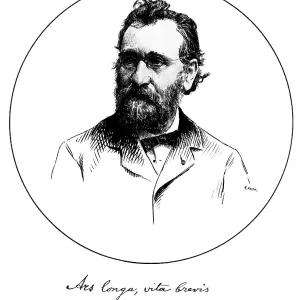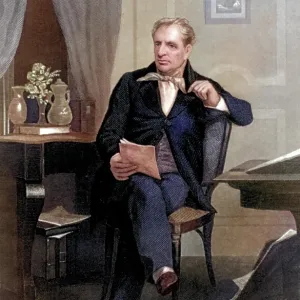
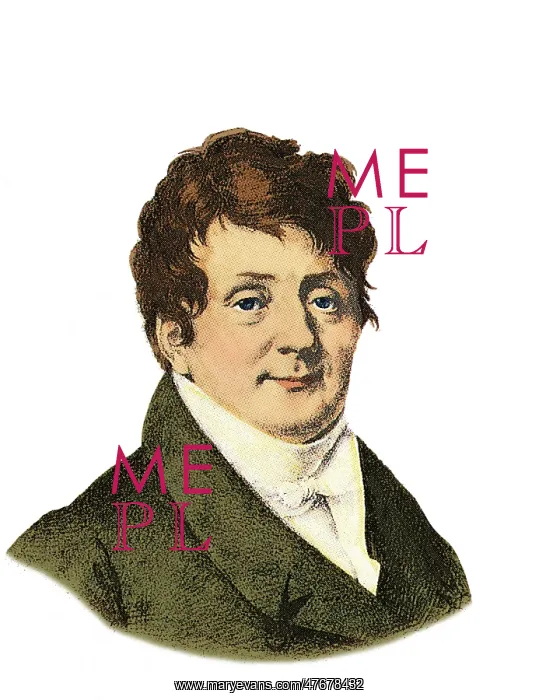
Joseph Fourier, French Mathematician and Physicist
Jean Baptiste Joseph Fourier (1768-1830) was a French mathematician and physicist best known for initiating the investigation of Fourier series and their applications to problems of heat transfer and vibrations. The Fourier series is an infinite series whose terms are constants multiplied by sine and cosine functions and that can, if uniformly convergent, approximate a wide variety of functions. The Fourier transform and Fourier's Law are also named in his honor. The Fourier transform: a technique for expressing a waveform as a weighted sum of sines and cosines. Fourier's Law: heat always conducts from warmer objects to cooler objects. Fourier is also generally credited with the discovery of the greenhouse effect. His is one of the 72 names of scientists inscribed on the Eiffel Tower
Pick your License
Restrictions Only for Ireland and United Kingdom
1700s 1768 Baptiste Colorised Colorization Conduction Credited Discovered Effect Eiffel Eighteenth Enhancement Fourier Furies Greenhouse Math Mathematical Mathematician Mathematics Transform
Features In These Collections
> Contributors > PHR