Joseph Priestley, Birmingham Riots, 1791
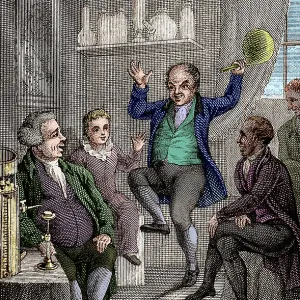
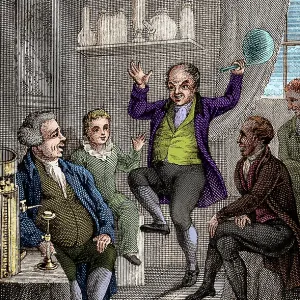
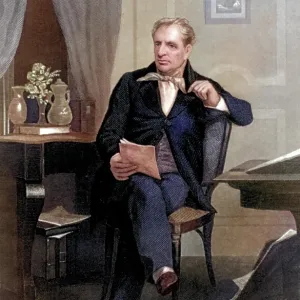
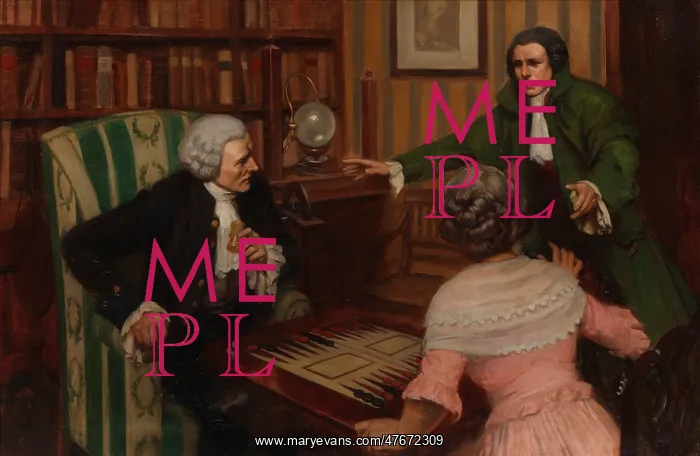
Priestley playing backgammon in his house in Birmingham when he received the news that it was about to be attacked by an anti-radical mob. The attacks took place on July 14-16 1791, and the library, furnishings and equipment represented in the present painting were all destroyed. Priestley himself fled to Hackney. Joseph Priestley (March 24, 1733 - February 6, 1804) was an English theologian, natural philosopher, chemist, educator, and political theorist who published over 150 works. Priestley's first scientific work, The History of Electricity (1767), was encouraged by Benjamin Franklin. His most famous scientific research was on the nature and properties of gases. By clever design of apparatus and careful manipulation, Priestley isolated and characterized eight gases, including oxygen and out of this work emerged his most important scientific texts: the six volumes of Experiments and Observations on Different Kinds of Air (1774-86). He also contributed to the understanding of photosynthesis and respiration. A scholar and teacher throughout his life, Priestley also made significant contributions to pedagogy, including the publication of a seminal work on English grammar and books on history, and he prepared some of the most influential early timelines. These educational writings were among Priestley's most popular works. It was his metaphysical works, however, that had the most lasting influence. By 1801, Priestley had become so ill that he could no longer write or experiment. He died in 1804 at the age of 70. Oil painting by Ernest Board, undated
Pick your License
Restrictions Only for Ireland and United Kingdom
1700s 1790s 1791 Educator Eighteenth Polymath Priestley Theologian Theologist Theorist
Features In These Collections
> Contributors > PHR