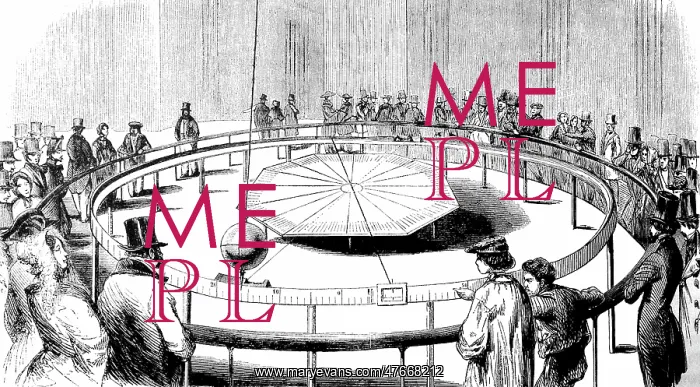


 : L @ on Foucault, Pendulum Experiment, 1851


L @ on Foucault, Pendulum Experiment, 1851

Leon Foucault's pendulum experiment in the Pantheon, Paris, in 1851. The Foucault pendulum is a simple device named after Lceon Foucault and conceived as an experiment to demonstrate the Earth's rotation. The pendulum was introduced in 1851 and was the first experiment to give simple, direct evidence of the earth's rotation. Jean Bernard Lceon Foucault (September 18, 1819 - February 11, 1868) was a French physicist. After an education received chiefly at home, he studied medicine, which he abandoned in favor of physics due to a blood phobia. He is best known for his demonstration of the Foucault pendulum, a device demonstrating the effect of the Earth's rotation by showing the rotation of the plane of oscillation of a long and heavy pendulum suspended from the roof of the Panthceon, Paris. The experiment caused a sensation in both the learned and popular worlds, and Foucault pendulums were suspended in major cities across Europe and America and attracted crowds. He joined Fizeau in measuring the speed of light. This measurement was improved when he developed a method of reflecting light off mirrors. Foucault showed that light moves slower in water which was important evidence for the wave-theory of light. He also discovered eddy currents, and is credited with naming the gyroscope (although he did not invent it). He died of what was probably a rapidly developing case of multiple sclerosis in 1868 at the age of 48. His is one of the 72 names inscribed on the Eiffel Tower
Picture No
12696264
Media ID
47668212
Size
4950px x 2736px (3.7MB)
Credit
Science Source/Mary Evans

Pick your License

Please tell us the book title or ISBN

Please supply intended use


Restrictions Only for Ireland and United Kingdom

Foucault Pantheon Pendulum Planetary Rotation


Features In These Collections

> Contributors > PHR

Gallery Wall Inspiration

Ilya Ilyich Mechnikov, Russian Immunologist
Laughing Gas, Nitrous Oxide
James Watt, Scottish Inventor and Engineer
Asteriornis ancient bird, illustration
Hesperornis ancient bird, illustration
Icthyornis ancient bird, illustration
Confuciusornis sanctus ancient bird, illustration
Deinonychus ancient bird art, illustration
Laughing Gas, Nitrous Oxide
Thames Water Drop, 1850
Michael Faraday and Father Thames, 1855
Thames Water Drop, 1850
Michael Faraday and Father Thames, 1855
Cellular Plant Tissue, Matthias Jakob Schleiden, 1847
Henry Maudsley, British Psychiatrist
Swimming Manual, Digby, 1587
Russian Pirates, 1805
Ilya Ilyich Mechnikov, Russian Immunologist
Johnny Appleseed, American Nurseryman
Saint Paul, Christian Apostle
James Fenimore Cooper, American Author
Arthrobotrys, SEM
Rhizopus sexualis, SEM
Flint Hatchet, Stone Age Tool


© Copyright Mary Evans Picture Library - All Rights Reserved 2026
Powered by Media Storehouse®
We accept all major payment options so you can pay for the things you need in the way that is most convenient for you
Facebook     Twitter     Instagram