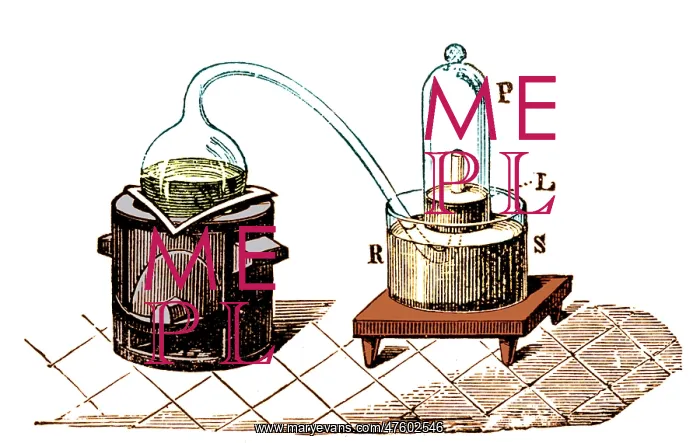
Lavoisier's Apparatus for Determining the Composition of Air
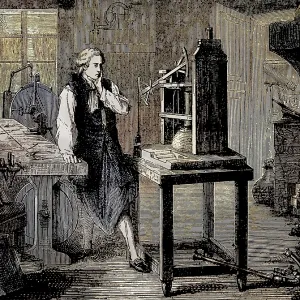
Illustration from an 1892 Chemistry book for Lavoisier's apparatus for determining the composition of air. Base of retort sits on a small furnace; open end passes into a container of liquid and is turned upwards, being covered by a bell jar. Lavoisier heated a small amount of mercury over a coal oven in a retort. The mouth of the retort was inserted in a bell-jar placed in a trough filled with mercury. The heating was continued for several days. After the first few days, he observed a reddish power on the surface of mercury in the retort. These changes continued for 12 days after which, formation of reddish powder stopped and no further increase was noticed in the level of mercury in the bell-jar. Lavoisier noticed that the rise in the level of mercury in the ball-jar was one-fifth of the capacity of the bell-jar. He found that the residual gas in the bell-jar was unfit for breathing and could not support combustion. This was later called nitrogen. Lavoisier collected the reddish powder and heated it strongly. He obtained a shiny, metallic metal (mercury) and a colorless, odorless gas which supported combustion. The volume of the gas was found to be equal to the increase in the volume of mercury in the bell-jar. This gas was named oxygen. When Lavoisier mixed oxygen and nitrogen, he obtained air. He thus concluded that air is made of two gases-nitrogen and oxygen which formed four-fifth and one-fifths part of air respectively
Pick your License
Restrictions Only for Ireland and United Kingdom
Chemical Chemistry Composition Determine Enhance Enhancement Gases Lavoisier Lavoisiers Mixture Nitrogen Oxygen Quantitative
Features In These Collections
> Contributors > PHR