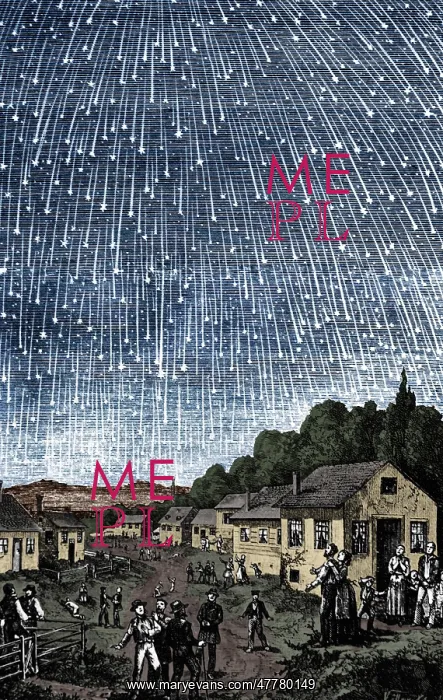


 : Leonid Meteor Shower, 1833


Leonid Meteor Shower, 1833

Colorized historical artwork of the spectacular Leonid meteor shower of November 13, 1833. The shower's three hour peak resulted in terror among the populace. As astronomers began to explore the physical nature of comets, they found that meteors came from dust left by comets. A meteor shower is a celestial event in which a number of meteors are observed to radiate, or originate, from one point in the night sky. These meteors are caused by streams of cosmic debris called meteoroids entering Earth's atmosphere at extremely high speeds on parallel trajectories. Most meteors are smaller than a grain of sand, so almost all of them disintegrate and never hit the Earth's surface. Major meteor showers such as the Leonids, seen here as they appeared on November 12, 1799, occurred as Earth plowed through a river of comet dust. The Leonid meteor shower peaks around November 17 of each year. Approximately every 33 years, the Leonid shower produces a meteor storm, peaking at rates of thousands of meteors per hour. Leonid storms gave birth to the term meteor shower when it was first realized, during the November 1833 storm, that the meteors radiated from near the star Gamma Leonis. The last Leonid storms were in 1999, 2001 (two), and 2002 (two). Before that, there were storms in 1767, 1799, 1833, 1866, 1867, and 1966. This artwork was made in 1889 for the Adventist book Bible Readings for the Home Circle
Picture No
13343377
Media ID
47780149
Size
2952px x 4664px (8.2MB)
Credit
© Science Source / Mary Evans Picture Library
Usage Restrictions
Commercial sales may require 3rd party clearance
Source
Science Source

Pick your License

Please tell us the book title or ISBN

Please supply intended use


Restrictions Only for Ireland and United Kingdom

1833 Celestial Comet Cosmic Leonid Meteor Phemomena Shower


Features In These Collections

> Contributors > PHR

Gallery Wall Inspiration

Ilya Ilyich Mechnikov, Russian Immunologist
Laughing Gas, Nitrous Oxide
James Watt, Scottish Inventor and Engineer
Asteriornis ancient bird, illustration
Hesperornis ancient bird, illustration
Icthyornis ancient bird, illustration
Confuciusornis sanctus ancient bird, illustration
Deinonychus ancient bird art, illustration
Laughing Gas, Nitrous Oxide
Thames Water Drop, 1850
Michael Faraday and Father Thames, 1855
Thames Water Drop, 1850
Michael Faraday and Father Thames, 1855
Cellular Plant Tissue, Matthias Jakob Schleiden, 1847
Henry Maudsley, British Psychiatrist
Swimming Manual, Digby, 1587
Russian Pirates, 1805
Ilya Ilyich Mechnikov, Russian Immunologist
Johnny Appleseed, American Nurseryman
Saint Paul, Christian Apostle
James Fenimore Cooper, American Author
Arthrobotrys, SEM
Rhizopus sexualis, SEM
Flint Hatchet, Stone Age Tool


© Copyright Mary Evans Picture Library - All Rights Reserved 2026
Powered by Media Storehouse®
We accept all major payment options so you can pay for the things you need in the way that is most convenient for you
Facebook     Twitter     Instagram