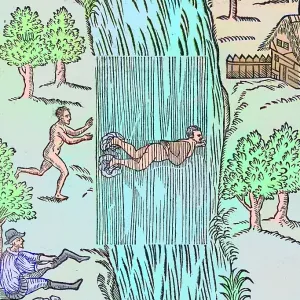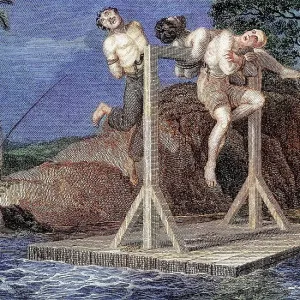
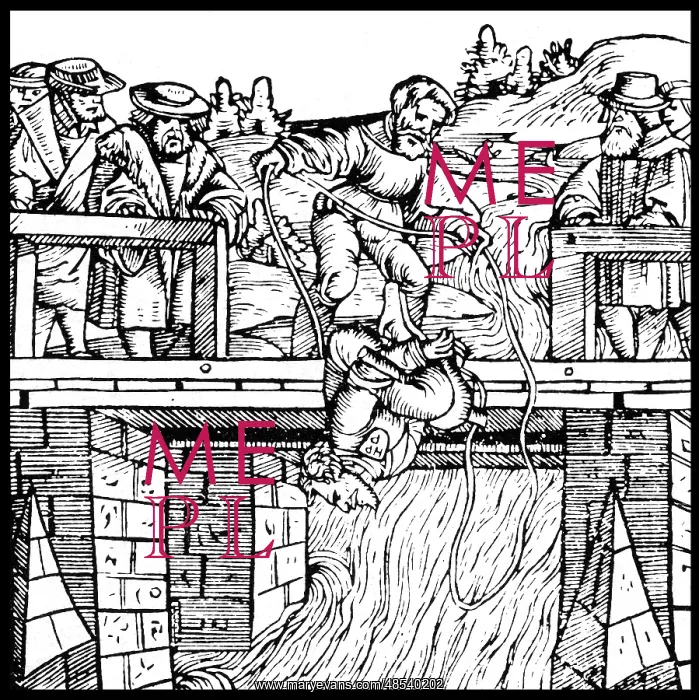
Medieval Execution by Drowning, 16th Century
Victims were drowned in rivers, lakes and village pons, in boast and barrels, and even in bowls and saucepans. Sometimes he or she was tied up in a sack with a dozen cats. Trial by ordeal was an ancient judicial practice by which the guilt or innocence of the accused was determined by subjecting them to a painful, or at least an unpleasant, usually dangerous experience. The test was one of life or death and the proof of innocence was survival. In some cases, the accused was considered innocent if they escaped injury or if their injuries healed. During the Middle Ages, a sentence of death was read using the words cum fossa et furca (with pit and gallows). Drowning survived as a method of execution in Europe until the 17th and 18th centuries. England had abolished the practice by 1623, Scotland by 1685, Switzerland in 1652, Austria in 1776, Iceland in 1777, and Russia by the beginning of the 1800s. German woodcut from an unknown source, early 1500s
Pick your License
Restrictions Only for Ireland and United Kingdom
1500s Cruel Cruelty Drowning Execute Executed Executing Executioner Infamous Inhumane Inhumanity Method Middles Notorious Ordeal Persecute Persecuted Persecuting Persecution Punish Punishing Sentence Sixteenth Suffering Torturer Torturing Woodblock
Features In These Collections
> Contributors > PHR