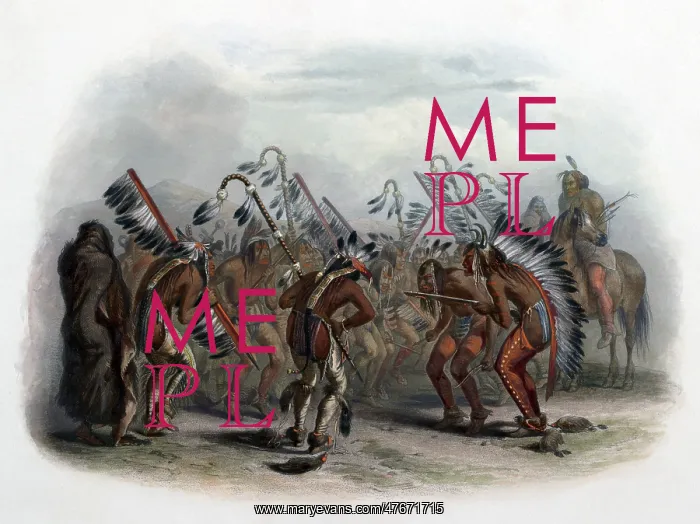
Native American Mandan Indian Dance, 1830s
Dances have always been significant in the lives of Native Americans. Dances played a vital role in religious rituals and other ceremonies; while others were held to guarantee the success of hunts, harvests, giving thanks, and other celebrations. Commonly, dances were held in a large structure or in an open field around a fire. Movements of the participants illustrated the purpose of the dance - expressing prayer, victory, thanks, mythology and more. Many tribes danced only to the sound of a drum and their own voices; while others incorporated bells and rattles. Some dances included solos, while others included songs with a leader and chorus. Participants might include the entire tribe, or would specific to men, women, or families. The Mandan are a Native American tribe of the Great Plains who have lived for centuries primarily in what is now North Dakota. The Mandan were a great trading nation, trading especially their large corn surpluses with other tribes in exchange for bison meat and fat. Voyage dans l'interieur de l'Amerique du Nord, execute pendant les annees 1832-34. Karl Bodmer (February 11, 1809 - October 30, 1893) was a Swiss printmaker, lithographer, painter, illustrator and hunter. He accompanied the German explorer Prince Maximilian zu Wied-Neuwied on his Missouri River expedition. Bodmer was hired as an artist to record images of cities, rivers, towns and peoples they saw along the way, including the many tribes of Native Americans along the Missouri River and in that region
Pick your License
Restrictions Only for Ireland and United Kingdom
Bodmer Ceremonies Ethnography Mandan Maximilian Missouri Plains Prairie Salvage Wied-neuweid Wied-neuwied
Features In These Collections
> Contributors > PHR