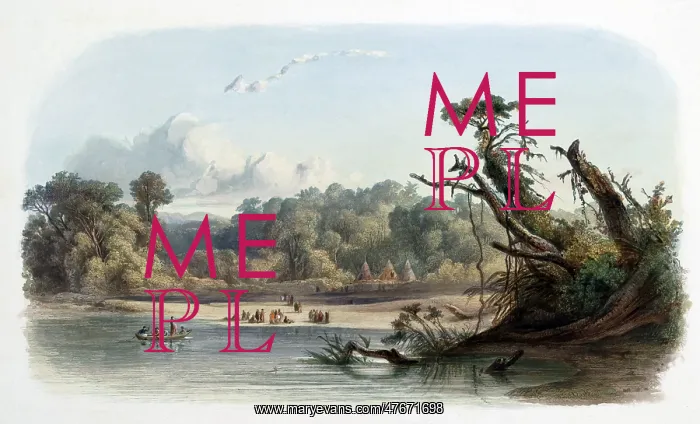
Native American Ponca Indian Encampment, 1830s
The Ponca are a Midwestern Native American tribe of the Dhegihan branch of the Siouan language group. The Ponca appear on a 1701 map by Pierre-Charles Le Sueur, who placed them along the upper Missouri. In 1789, fur trader Juan Baptiste Munier was given an exclusive license to trade with the Ponca at the mouth of the Niobrara River. Shortly after that, the tribe was hit by a devastating smallpox epidemic. In 1804, when they were visited by the Lewis and Clark Expedition, only about 200 Ponca remained. Later in the 19th century, their number rose to about 700. Most of the leadership of the Ponca people was destroyed in 1824. Unlike most other Plains Indians, the Ponca grew maize and kept vegetable gardens. Their last successful buffalo hunt was in 1855. Voyage dans l'interieur de l'Amerique du Nord, execute pendant les annees 1832-34. Karl Bodmer (February 11, 1809 - October 30, 1893) was a Swiss printmaker, lithographer, painter, illustrator and hunter. He accompanied the German explorer Prince Maximilian zu Wied-Neuwied on his Missouri River expedition. Bodmer was hired as an artist to record images of cities, rivers, towns and peoples they saw along the way, including the many tribes of Native Americans along the Missouri River and in that region
Pick your License
Restrictions Only for Ireland and United Kingdom
Bodmer Cone-shaped Conical Encampments Ethnography Maximilian Missouri Ponca Salvage Teepee Tipi Wied-neuweid Wied-neuwied
Features In These Collections
> Contributors > PHR