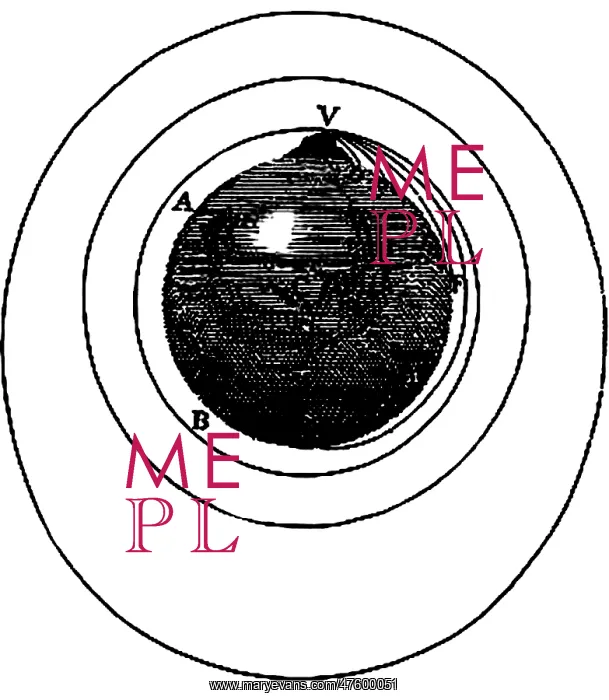
Newton's Projectile, Principia, 1687
Newton's famous mountain projectile diagram taken from Principia (1687), his treatise on the laws of motion and gravitation. The mountaintop at V is supposed to be above the earth's atmosphere, and for a suitable initial speed, the projectile orbits the earth in a circular path. In fact, the earth's curvature is such that the surface falls away below a truly flat horizontal line by about five meters in 8, 000 meters (five miles). Recall that five meters is just the vertical distance an initially horizontally moving projectile will fall in the first second of motion. But this implies that if the (horizontal) muzzle velocity were 8, 000 meters per second, the downward fall of the cannonball would be just matched by the earth's surface falling away, and it would never hit the ground! Translation: a projectile would never hit the ground if it was launched from high in the Earth's atmosphere with enough initial speed. Instead, it would remain in orbit around the Earth, prevented from flying away by the force of gravity
Pick your License
Restrictions Only for Ireland and United Kingdom
1642 1727 Alchemist Astronomer Calculus Differential Gravity Integral Isaac Knighted Mathematica Mathematician Mechanics Naturalis Polymath Practical Principia Projectile Reflecting Telescope Theologian
Features In These Collections
> Contributors > PHR