

 : Phases of the Moon, 1844 Diagram


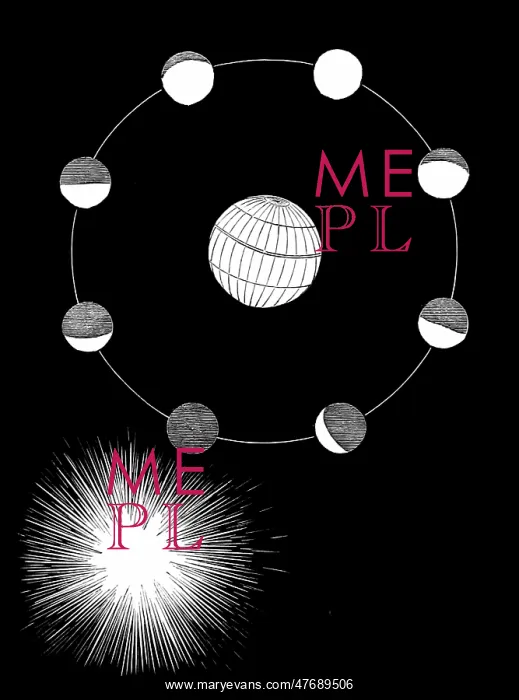
Phases of the Moon, 1844 Diagram

We always see the same side of the moon, because as the moon revolves around the Earth, the moon rotates so that the same side is always facing the Earth. But the moon still looks a little different every night. Sometimes the entire face glows brightly. Sometimes we can only see a thin crescent. Other times the moon seems to disappear entirely. As the bright parts of the moon appear to change shape during the month, each stage of the change is called a phase, and each phase carries its own name. This chart shows why this happens. The center ring shows the moon as it revolves around the Earth, as seen from above the north pole. Sunlight illuminates half the Earth and half the moon at all times. But as the moon orbits around the Earth, at some points in its orbit the sunlit part of the moon can be seen from the Earth, and at other points, we can only see the parts of the moon that are in shadow. The outer ring shows what we see on the Earth during each corresponding part of the moon's orbit. Image taken from page 20: Six Thousand Years Ago: or, the Works of Creation by M.C. Best, 1844

Picture No
12697220
Media ID
47689506
Size
3225px x 4350px (1.0MB)
Credit
British Library/Science Source/Mary Evans

Pick your License

Please tell us the book title or ISBN

Please supply intended use


Restrictions Only for Ireland and United Kingdom

1844 Astronomic Astronomical Crescent Diagram Firma Lunar Phases Satellite Terra Waking Waning


Features In These Collections

> Contributors > PHR
Gallery Wall Inspiration

Ilya Ilyich Mechnikov, Russian Immunologist
Laughing Gas, Nitrous Oxide
James Watt, Scottish Inventor and Engineer
Asteriornis ancient bird, illustration
Hesperornis ancient bird, illustration
Icthyornis ancient bird, illustration
Confuciusornis sanctus ancient bird, illustration
Deinonychus ancient bird art, illustration
Laughing Gas, Nitrous Oxide
Thames Water Drop, 1850
Michael Faraday and Father Thames, 1855
Thames Water Drop, 1850
Michael Faraday and Father Thames, 1855
Cellular Plant Tissue, Matthias Jakob Schleiden, 1847
Henry Maudsley, British Psychiatrist
Swimming Manual, Digby, 1587
Russian Pirates, 1805
Ilya Ilyich Mechnikov, Russian Immunologist
Johnny Appleseed, American Nurseryman
Saint Paul, Christian Apostle
James Fenimore Cooper, American Author
Arthrobotrys, SEM
Rhizopus sexualis, SEM
Flint Hatchet, Stone Age Tool


© Copyright Mary Evans Picture Library - All Rights Reserved 2026
Powered by Media Storehouse®
We accept all major payment options so you can pay for the things you need in the way that is most convenient for you
Facebook     Twitter     Instagram