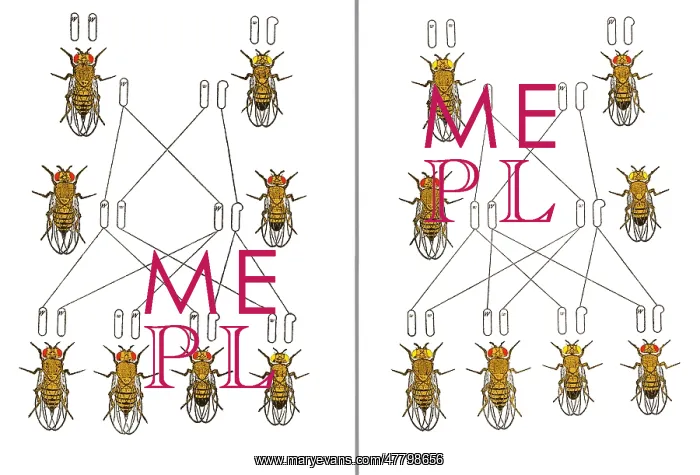
Physical Basis of Heredity, T.H. Morgan, 1919
Cross between white-eyed male and red-eyed female of the vinegar fly. From The physical basis of heredity by Thomas Hunt Morgan, 1919. Thomas Hunt Morgan (1866-1945) was the recipient of the 1933 Nobel Prize in Medicine for his discoveries of the role played by chromosomes in heredity. Morgan received his Ph.D. in 1890 at Johns Hopkins University. The work that received the prize was completed over a 17-year period at Columbia University by Morgan and his students, commencing in 1910 with his discovery of the white-eyed mutation in the fruit fly, Drosophila. This led to the discovery of sex-linked inheritance, allowing chromosomes to be identified as the carriers of the hereditary material
Pick your License
Restrictions Only for Ireland and United Kingdom
Basis Biologist Breeding Chromosomes Embryologist Embryology Evolutionary Geneticist Genetics Heredity Inheritance Physiology Red-eyed Textbook Vinegar White-eyed
Features In These Collections
> Contributors > PHR