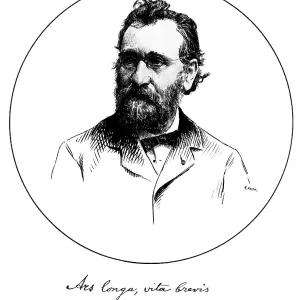
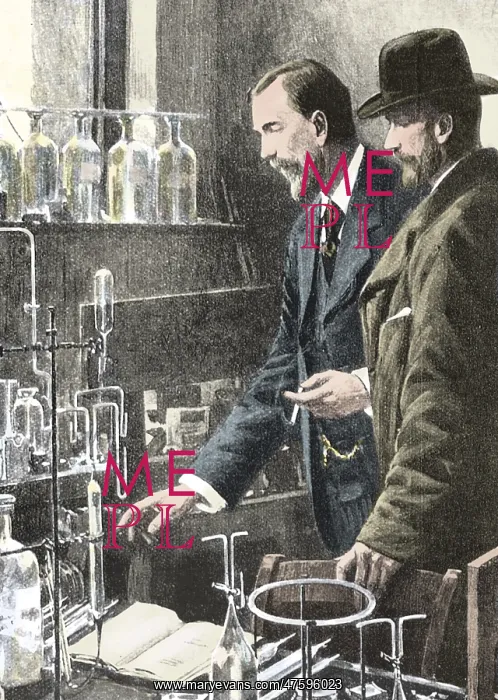
Pierre Curie, French Physicist
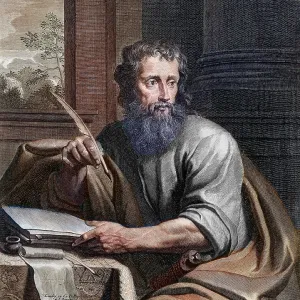
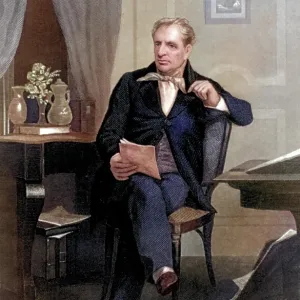
Pierre Curie (1859-1906) was a French physicist, a pioneer in crystallography, magnetism, piezoelectricity and radioactivity, and Nobel laureate. In 1903 he received the Nobel Prize in Physics with his wife, Marie Salomea Sklodowska-Curie, and Henri Becquerel. Prior to his famous doctoral studies on magnetism, he designed and perfected an extremely sensitive torsion balance for measuring magnetic coefficients. Variations on this equipment were commonly used by future workers in that area. Pierre Curie studied ferromagnetism, paramagnetism, and diamagnetism for his doctoral thesis, and discovered the effect of temperature on paramagnetism which is now known as Curie's law. The material constant in Curie's law is known as the Curie constant. He also discovered that ferromagnetic substances exhibited a critical temperature transition, above which the substances lost their ferromagnetic behavior. This is now known as the Curie point. Pierre worked with his wife Marie Curie in isolating polonium and radium. They were the first to use the term radioactivity, and were pioneers in its study. Pierre and one of his students made the first discovery of nuclear energy, by identifying the continuous emission of heat from radium particles. The curie is a unit of radioactivity originally named in honor of Curie by the Radiology Congress in 1910, after his death. Pierre Curie died in a street accident in 1906. Crossing the busy Rue Dauphine in the rain he slipped and fell under a heavy horse drawn cart. He died instantly when one of the wheels ran over his head, fracturing his skull
Pick your License
Restrictions Only for Ireland and United Kingdom
Coefficients Constant Crystallography Curie Curies Diamagnetism Discovered Doctoral Enhancement Fractured Isolated Laureate Magnetic Magnetism Measuring Nobelist Particles Piezoelectricity Polonium Radioactivity Radium Recipient Studies Torsion
Features In These Collections
> Contributors > PHR