Preformationism, 18th Century
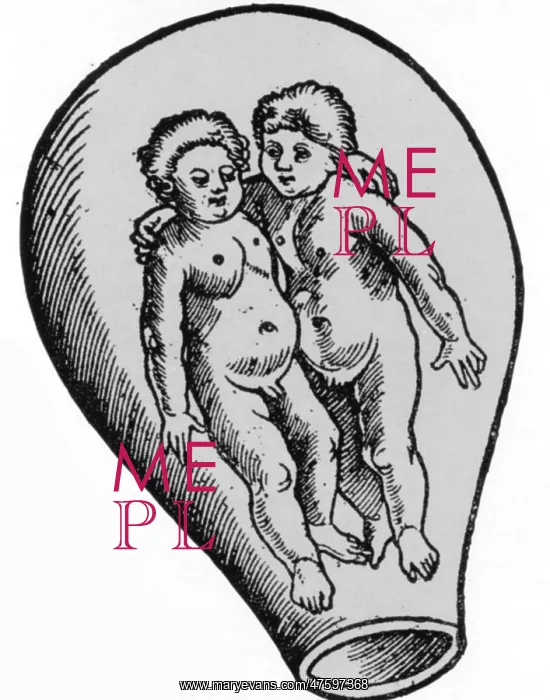
One of the most important issues in the premodern biology of the 18th century was the struggle between preformationist and epigenetic theories of development. The preformationists believed that living things develop after conception from miniature versions of the adult, fully formed organisms that simply enlarge in size from their tiny origin in germ (egg) or sperm. They assumed that the germs of all living beings were preformed and had been since the Creation. The Deistic theory of preformism assumed that God had determined the organizational forms of all organisms at the creation of the world. After that, the mechanical laws of matter did the rest. Thus preformism could be a mechanistic theory in which the divine watchmaker conceives a plan of the object which guides its production. According to Descartes, if one knew in detail all the parts of the seed of a particular species of animal, for instance, Man, one could deduce from that alone for reasons entirely mathematical and certain, the whole figure and conformation of each of its parts. For preformationists, the egg, or rather the germ, supposedly housed a homunculus, a tiny version of the adult, each part of which expanded into the corresponding part of the adult
Pick your License
Restrictions Only for Ireland and United Kingdom
Biology Birthing Conception Deistic Divine Formed Fully Germ Homunculus Interpretation Organism Pregnancy Pregnant Prenatal Reproduction Siblings Theory Tiny Twins Watchmaker Womb
Features In These Collections
> Contributors > PHR