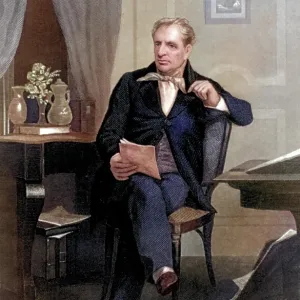

Prince Maximilian and Karl Bodmer Meet Hidatsa Indians, 1830
Prince Maximilian and Bodmer meeting with Hidatsa Indians, Fort Clark. In 1830, a representative of the American Fur Company built Fort Clark Trading Post south of the Mandan Indian village. The first steamboat to journey up the upper-Missouri River was the Yellowstone which arrived in 1832 carrying 1, 500 gallons of goods and liquor. In 1837, the steamboat St. Peters docked at the village carrying passengers infected with smallpox, and sparking the 1837 Great Plains smallpox epidemic. The Hidatsa, called the Minnetaree by the Mandan, are a Siouan people. Tribal appearance and customs have been documented by the visits of two artists of the American west. George Catlin and Karl Bodmer's works record the Hidatsa and Mandan societies, where were rapidly changing under pressure from encroaching settlers, infectious disease, and government restraints. Voyage dans l'interieur de l'Amerique du Nord, execute pendant les annees 1832-34. Karl Bodmer (February 11, 1809 - October 30, 1893) was a Swiss printmaker, lithographer, painter, illustrator and hunter. He accompanied the German explorer Prince Maximilian zu Wied-Neuwied on his Missouri River expedition. Bodmer was hired as an artist to record images of cities, rivers, towns and peoples they saw along the way, including the many tribes of Native Americans along the Missouri River and in that region
Pick your License
Restrictions Only for Ireland and United Kingdom
Bodmer Ethnography Hidatsa Hiraacǭ Maximilian Minnetaree Missouri Plains Prairie Salvage Trading Wied-neuweid Wied-neuwied
Features In These Collections
> Contributors > PHR